
Event Award Planning
From class list to podium — the sequence that gets awards to the ceremony on time
Short answer
A practical planning sequence for event organizers: decide what the awards are for, settle the class list and quantities, choose formats and budget, send artwork, approve a proof, then plan delivery, staging and the ceremony itself. Each stage below links to the guide that covers it in depth. No minimum order, free design proofs, and lead times confirmed against your date rather than assumed.
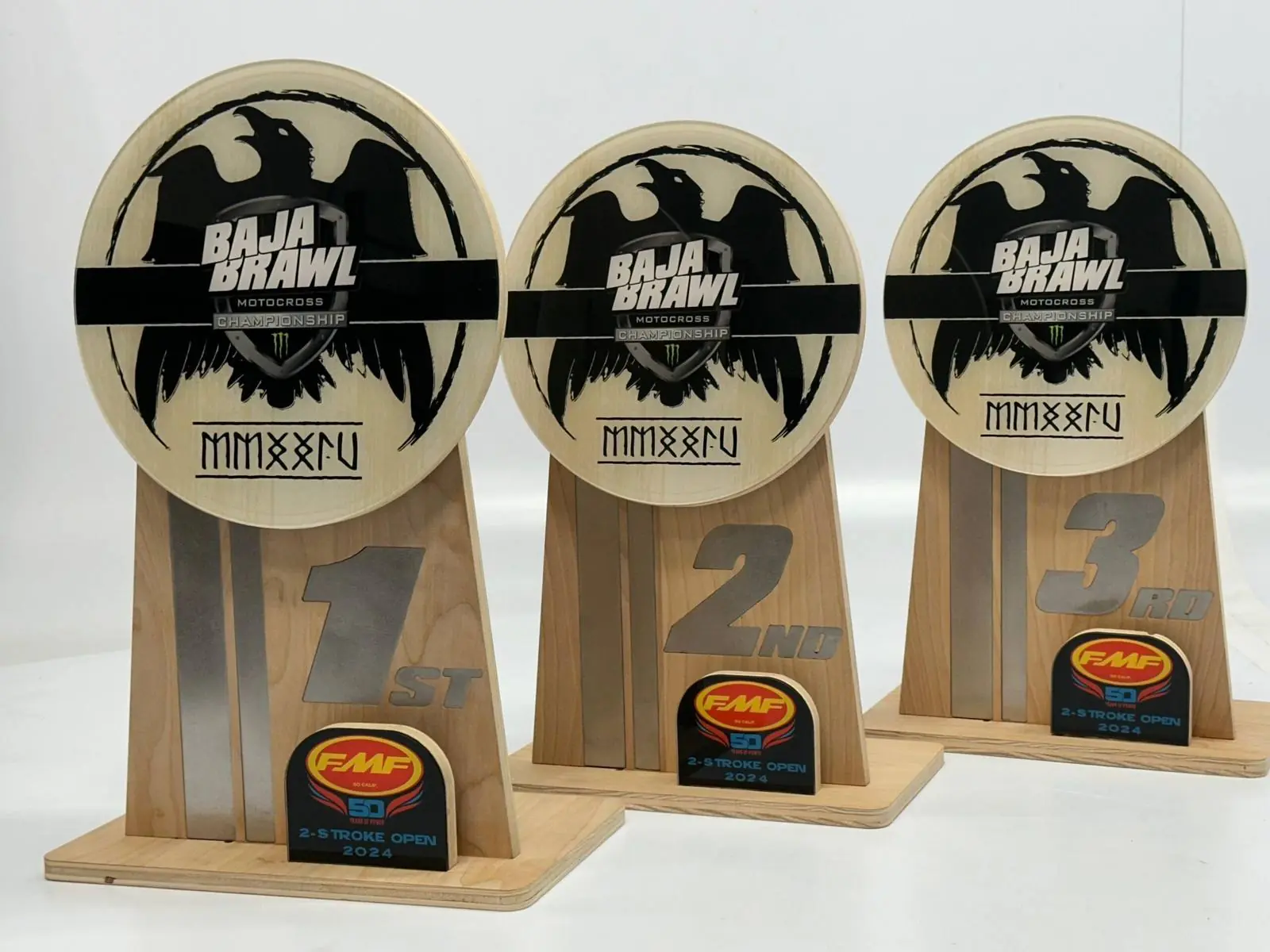
Awards are a project, not a purchase
The trophies are one line on a planning spreadsheet and they touch almost everything else on it: registration supplies the class list, judging supplies the placings, sponsors supply artwork, and the ceremony depends on all three arriving correctly and on time.
Nearly every awards problem is a planning problem that surfaced late. A class added after proofs were approved, a logo sent as a screenshot, a sponsor added the week of the event, or no one named to approve the artwork — none of those are production issues, and all of them end up looking like one.
What follows is the sequence that avoids them, with the decision at each stage and the guide that covers it properly.
A planning timeline that works backwards from the date
Twelve weeks is comfortable for a judged multi-class event. With less time the order of the steps still holds — each one compresses, and the proof review is the one to protect.
- Twelve weeks out — decide what the awards are for. Recognition of craftsmanship, encouragement of attendance, sponsor visibility, or a club tradition. Everything downstream follows from this, and it is the one step organizers routinely skip. What awards actually do for an event is worth reading before the budget conversation.
- Ten weeks — settle the class list and the count. One award per placing per class, plus the specials, plus the participation tier if you are running one. Get this from pre-registration rather than last year’s memory. Bulk ordering for events covers the quantity worksheet.
- Eight weeks — choose the format and set the budget. Which pieces carry weight and which need to scale. Choosing a trophy style and what event trophies cost are the two decisions here.
- Seven weeks — send artwork and get a quote. Logos, class names as they will be read aloud, the event name as it appears on the flyer, and the year. Preparing your logo saves the most back-and-forth of any single step.
- Six weeks — review the proof properly. Spellings, placings, sponsor marks, and whether the hierarchy reads. Two people, independently. This is the last cheap moment to change anything.
- Four weeks — plan the ceremony. Presentation order, who announces, who hands over, and how winner names reach the announcer without being retyped at the podium.
- Two weeks — confirm delivery and staging. Who receives the boxes, who counts them against the list, and where they are stored. Shipping awards without delays covers the handover.
- Event day — stage, present, photograph. Group by presentation order rather than by class. Photograph the full lineup before anything is handed out, because afterwards it no longer exists.
The most reliable deadline is not the event date. It is the date the awards need to be in your hands so they can be counted and staged, which is usually several days earlier than organizers assume.
The six decisions
How much should this cost?
What actually drives the number — size, layers, artwork complexity and quantity — and how to build a figure you can defend to a committee.
Which format for which award?
Matching the piece to the job: a signature top award, a coordinated class family, and something that reaches everyone who turned up.
How many do we need?
Placings times classes, plus specials, plus spares. The arithmetic is simple; the omissions are what cost money.
What fits on the award?
Event name, class, placing, year and a row of sponsor marks all have to be readable at arm’s length. Size follows the content, not the other way round.
When do we have to order?
Working backwards from the date the awards must be in your hands — not the event date — through staging, delivery, production and proof review.
What usually goes wrong?
The recurring failures: late class changes, artwork sent as a screenshot, no spares, and nobody named as the approver.

Three tiers, not one list
Most award programmes that go wrong do not have a bad trophy in them. They have one undifferentiated list, so nothing on the table signals which award is the honour of the day. A hierarchy fixes it, and it usually needs only three levels.
- One signature piece. The overall or grand champion award, given enough design attention that it reads differently from everything else in the lineup.
- One coordinated family. Every class award sharing a form, colour direction and title treatment, with only the class name changing. A row of these reads as one event.
- One participation tier. Whatever reaches the rest of the field — medallions, dash plaques, pins. This is the item most likely to still be in the vehicle or on the wall a year later.
Because there is no minimum order the tiers do not need to be balanced. One signature piece, eight class awards and two hundred participation items is a perfectly normal shape.
The awards nobody budgets for
Almost every event discovers these late, and they are the reason a second order gets placed at the worst possible moment.
- Sponsors. A presenting sponsor usually expects a thank-you piece, and it should not look like a class award with a different label.
- Judges, marshals and volunteers. The people who made the event run. Cheap to include in the original order, awkward to add afterwards.
- Ties and disputes. Decide in advance whether a tie means two awards or a countback, because the answer changes the quantity.
- Spares. A name is always missed or misspelled. A few blanks in the same batch cost far less than a separate rush order.
What the ceremony needs from the awards
Staging is where the planning either pays off or does not. Group the awards in presentation order rather than by class or by the box they arrived in, and keep a duplicate list of categories and recipients away from the table.
Give the announcer the names in writing, with pronunciation notes where they are needed. Have someone whose only job is handing the right piece to the presenter. And photograph the full lineup before the ceremony starts — after it, the collection no longer exists, and those photographs are what promotes next year’s event.
If the event is a car show rather than a race, the same sequence applies with a different category structure: see how to plan car show awards.
Event Award Planning FAQs
How far ahead should we start planning event awards?
Twelve weeks is comfortable for a judged event with several classes. If you have less, the order of the steps still holds — each one simply compresses. Contact us for current lead times as soon as you have a date and a class list.
How many trophies do we need?
Multiply placings by classes, then add special awards, sponsor and volunteer pieces, and a small contingency. Base the participation tier on realistic registration rather than optimistic registration.
Who should approve the artwork?
One named person. Proof cycles stretch when several people send separate corrections, and the approver is the single decision that most affects whether awards arrive on time.
What should we check on a proof?
Event name, date, class wording, placings, spellings, sponsor marks, quantities and the visual hierarchy. Have two people check independently — the second reader catches what the first stopped seeing.
Do we need an award for everyone?
Not a trophy, but a participation piece is worth considering. Dash plaques, medallions and pins reach the whole field at a cost that does not compete with the podium budget.
Is there a minimum order?
No. A single replacement award is a normal order, and so is a full season across every class.

Send the class list and we will build the programme around it
Tell us the event name, date, class or category list, quantities and any logo or sponsor artwork. We will come back with a direction and a proof before anything goes into production.
There is no minimum order, so a single presentation piece is as workable as a full season across every class.


