




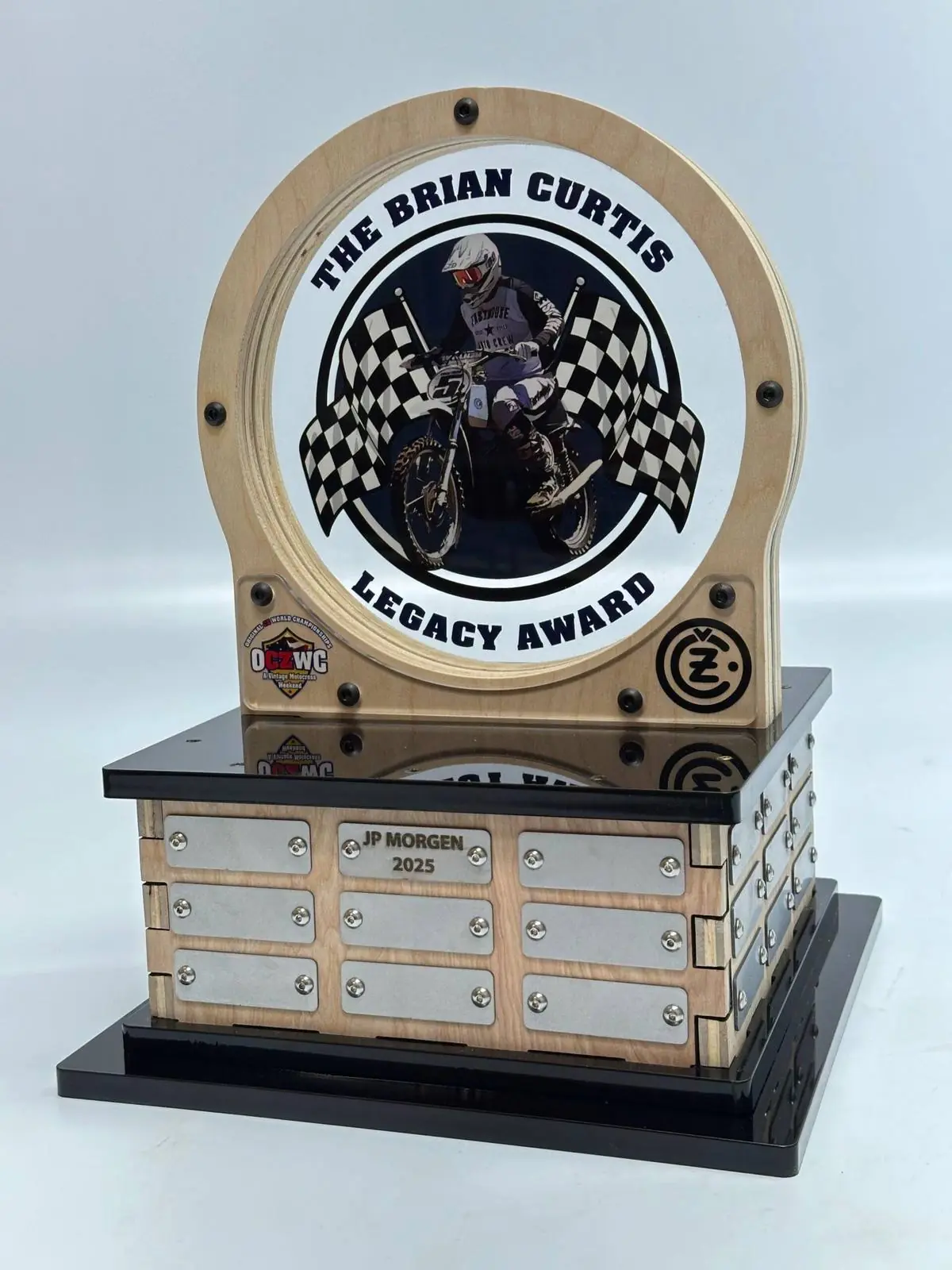
A series or track banquet is different from a team banquet. There are more classes, more families, riders from age four to sixty, sponsors who expect to be seen and a season of results that has to be read out in the right order. The evenings that go well are planned around the awards, because the awards are the reason most people bought a ticket.
This guide covers a racing banquet from the date to the last photograph: venue, tickets, a run of show, who presents, how to set up the awards table, the photo backdrop, the printed program and what to do with awards for riders who are not there. For a general team banquet, see sports banquet ideas.
Date and venue
Pick the date first, because everything else is worked back from it, including the awards.
- After results are final. Allow time after the last round for protests, corrections and the series to sign off the standings. Names cannot go on awards until they do.
- Away from the holidays. Many series hold the banquet in the off-season once the holidays are over, when families have free weekends and before next season’s first round.
- Check the other series. Riders often race more than one series. A clash with another banquet in the region costs you families.
- A room with a stage and a wall. You need a raised area people can see from every table, a wall or space for the photo backdrop, room for the awards table near the stage and a clear path from the tables to the stage.
- Parking and children. Racing banquets are family nights. Somewhere children can move around, and enough parking for trucks, matters more than the menu.
Tickets and who comes
Decide early who is invited and who pays. The usual approach is that ticket sales cover the meal and the series covers the awards.
- Award winners. Many series include the winner’s ticket and sell tickets to their families. Say so in the invitation, because it changes how many riders come.
- Families and fans. Sold at one price, with a lower price or free entry for young children.
- Sponsors. Complimentary seats for sponsor representatives, especially anyone presenting an award.
- Crew and volunteers. Invite them as guests. They worked every round for free.
Close ticket sales on a fixed date so the venue has a head count, and ask riders who are award winners to say whether they are coming. That answer decides what happens at the awards table, as the last section explains.
A run of show for a racing banquet
The order below suits a series with a meal and a full set of class awards. The class awards are the longest part, so the rest is kept short.
| Segment | What happens | Notes |
|---|---|---|
| Doors and dinner | Seating, food, season photos on a screen | Awards table visible but covered or roped off |
| Welcome | Emcee opens, explains the order of the night | Under three minutes |
| Season recap | Series director or promoter looks back on the season | The story, not every result |
| Memorial moment | Riders, crew or family lost during the year | Brief, quiet, before any celebration |
| Category awards | Rookie, most improved, sportsmanship, hard charger, iron man | Lighter mood, builds the room |
| Sponsors | Thanks to every sponsor, sponsor of the year, sponsor-presented awards | Name each sponsor once |
| Volunteers and crew | Thank-yous by role | Call the crew up together |
| Class awards | Youngest class first, oldest last | Same pattern for every class |
| Champions | Overall and premier class champions, perpetual trophies | The last moments of the night |
| Close | Group photo of champions, thanks, next season’s dates | Keep champions near the stage |
Presenting the youngest classes first is the common racing order for a practical reason as well as a sentimental one: the 50cc riders and their families can leave at a reasonable hour, and the room stays full for the champions. Within each class, present from the lowest place awarded up to the class champion. The award ceremony program guide covers timing per award in more depth, and points championship awards covers overall titles and ties.
Presenters and the emcee
One emcee holds the night together. The best emcee at a racing banquet is often the series announcer, who already knows every rider’s name and how to say it.
- Series director or promoter. The season recap and the champions.
- Sponsors. The awards they fund, if they are presenting one. See sponsor-presented awards.
- Class presenters. A respected rider, a past champion or a long-serving official for each group of classes. It spreads the night and gives the riders someone they know.
- Hand-off person. One person at the awards table who hands each award to the presenter in order. This is the role that prevents mix-ups.
For the words, the award ceremony script can be adapted for a series, and how to present an award helps class presenters who have never done it before.
The awards table
Most banquet mistakes happen at the awards table: the wrong rider handed the wrong place, a trophy left in a box, a class presented twice. A table set up in presentation order prevents nearly all of them.
- Check every award against the list when it arrives. Class, place, name and spelling. Do it at home or at the office, not at the venue.
- Sort by presentation order, not by class number. The table should be set in the same order as the emcee’s script, starting at the end nearest the stage.
- Label each group. A card at the front of each class with the class name and the order it is presented in. A small sticky note on the back or base of each award with the rider’s name and place.
- Keep a printed copy of the list at the table. The hand-off person ticks each award as it goes up.
- Hold the champions and perpetual trophies apart. At the far end, or on their own table, and covered until they are presented.
- Have a box for absent winners. Awards for riders who are not there go into it as their class is read, so they are not left among the others.
A printed table cover with the series logo makes the awards table part of the room rather than a folding table in the corner. For the whole sequence from class list to the night itself, see event award planning.
Photos and the backdrop
Every winner wants one photograph, and families will take hundreds more. Plan one spot for it.
- A backdrop banner beside the stage. The series logo and the season, with sponsor logos if they were promised. Winners step off the stage and in front of it. Banners are made in the sizes these backdrops need.
- One photographer, one spot. The photographer stays at the backdrop. Families can take their own from the floor.
- Class photos. After each class, everyone who placed in it, in order, holding their awards facing the camera.
- Champions photo. All the champions together at the close, before anyone leaves.
Send the photographs to riders and sponsors after the night. A good photograph of a sponsor with a winner is worth more to that sponsor than anything said on stage.
The printed program
A program at each seat tells families when their rider’s class is coming, which keeps the room calmer during a long class segment. A good racing banquet program has the run of show, the classes in presentation order with the places awarded, the sponsor list and a line for anyone remembered in the memorial moment. Leave out the winners’ names if any results could still change, or if you want the announcements to land. MX also makes printed materials in the series’ own design.
Awards for riders who are not there
Some winners will not come. Decide the policy in advance and announce it with the tickets.
- Read the name anyway. Every winner is named in the class, in order, whether present or not. A rider who earned third should hear it said, even later from a parent.
- Let a teammate or family member accept. Common and well received. Ask them to step up when the name is read.
- Hold the award, then hand it over at the first round. Many series present unclaimed awards at the first race of the next season, at the riders’ meeting or on the podium.
- Set a time limit. State how long the series will hold unclaimed awards and whether it will ship them at the rider’s cost.
Whatever the policy, keep unclaimed awards together with a list, so nothing sits in someone’s garage for a year. More on the season-end order as a whole, from the class list to delivery, is on end-of-season awards. When you are ready, work back from the date the awards must be in your hands and ask us for the current lead time against it; how far in advance to order shows how.
Frequently Asked Questions
In what order are awards presented at a racing banquet?
Category awards and sponsor awards first, then class awards from the youngest class to the oldest, and the overall and premier class champions last. Within each class, present from the lowest place awarded up to the champion.
How long should a racing banquet last?
Long enough for dinner and every class, and no longer. Keep the recap and speeches short, use the same pattern for every class, and present the youngest classes early so families with small children can leave.
Who should emcee a racing banquet?
The series announcer is usually the best choice, because they know every rider’s name and how to pronounce it. A promoter or long-serving official also works well.
What do we do with awards for riders who do not attend?
Read every name anyway, let a family member or teammate accept if they can, and hold the rest to present at the first round of next season. Announce the policy with the tickets.
How should the awards table be arranged?
In presentation order, matching the emcee’s script, with a label for each class and a name note on each award. Keep the champions and perpetual trophies apart, and have one person hand each award to the presenter.
Have your award list?
Send the class list, the award list in presentation order and the date the awards must be in your hands. Every award is laid out on a free design proof for you to approve before anything is produced.
See end-of-season awards


