




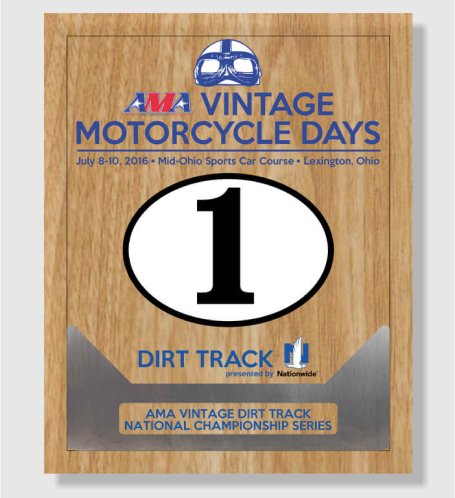
A points championship ends with a list of names and a stack of awards, and the two have to match. Most banquet problems trace back to decisions that were never written down: how many places a small class receives, whether a rider who missed half the season can still finish third, what happens when two riders end on the same points.
This guide walks through the choices a series makes when it structures its season-end awards, in the order you will need them. Nothing here is a rule. Every series and sanctioning body writes its own, and riders accept almost any reasonable system as long as it was published before the first gate dropped.
What your points award rules need to settle
Before you count trophies, the series rules should answer six questions. If the rulebook is silent on any of them, settle it now and publish the answer.
- How many places are awarded in each class, and does that change with class size?
- Is there a minimum number of rounds to be eligible for a season award?
- Are any rounds dropped from each rider’s total?
- How are ties in the final standings broken?
- Is there an overall champion, and how is it decided?
- How are points handled for riders who race more than one class, or move class mid-season?
How many places to award per class
The usual answer is the top three, five or ten in each class. The right depth depends on how many riders race the class regularly, not on how many entered once. Awarding ten places in a class with eight regulars means everyone gets an award, which turns a points award into a participation award. Awarding three places in a class of forty leaves strong seasons unrecognized.
A common approach is to scale the depth to the number of riders who scored points at a set share of rounds:
| Regular riders in the class | Places awarded | Why |
|---|---|---|
| 1 to 4 | Champion only, or champion and runner-up | Keeps the award meaningful in a thin class |
| 5 to 9 | Top three | The traditional podium |
| 10 to 19 | Top five | Recognizes a deep field without diluting the title |
| 20 or more | Top ten | Common in large amateur and youth classes |
Publish the scale with the season rules so a rider in a small class knows from the start what is available. Count regular riders near the end of the season, when you know who actually raced, and keep the scale the same every year.
For a full count across classes, special awards and sponsors, see how many awards for a banquet.
Minimum rounds and attendance rules
Many series require a rider to start a minimum number of rounds, often a half or two-thirds of the schedule, to be eligible for a season award. The rule protects riders who came every weekend from losing a top-five place to someone who raced three rounds and won them.
- State it as a number of rounds, not a percentage, so nobody has to do arithmetic in the pits.
- Say what counts as a start. Signing in, taking the gate in the first moto, or finishing a race are three different things.
- Say what happens to canceled rounds. If weather cancels a round, the minimum usually drops with it, but write that down.
- Decide whether the rule applies to the champion only or to every awarded place.
If your series drops each rider’s worst round or rounds from the total, that also belongs in the published rules, along with how many are dropped and whether a missed round counts as a dropped one. It changes who finishes where, so it cannot be decided after the final round.
Tie-breaks
Two riders on the same points at the end of a season is more common than people expect, especially in small classes. Series handle it in different ways. The common approaches, usually applied in sequence until the tie is broken, are:
- Most wins over the season, then most second places, then most thirds.
- Better finish at the final round. Simple, and it rewards the rider who closed the season stronger.
- Head-to-head record in the rounds where both riders finished.
- More rounds started. Rewards attendance, which many club series value.
- Shared place. Both riders receive the same place and the next place is skipped.
Whichever you choose, publish the order before the season. If a tie is possible going into the final round, tell both riders how it will be broken before they line up. If you allow shared places, make two awards for that place and leave the next one off.
Overall titles versus class titles
A class champion beat the riders in one class. An overall or grand champion title says something about the whole series, so it needs its own written definition. Series usually choose one of these:
- A combined class, such as an open or overall class scored in its own right.
- Total points across classes for riders who race more than one, which favors riders with the most entries.
- Best result in a premier class, with the overall title going to the champion of the top class.
- A judged award chosen by officials from among the class champions, which should then be named something other than overall champion.
The overall award is often the one piece built as a perpetual trophy, with a keeper for each year’s winner. For how a series championship differs from awards at one race, see motocross series vs single event trophies.
Riders who race more than one class
A rider who finishes in the top three of two classes receives two awards. That is the norm, and it is what the rider earned. The questions to settle are about points, not awards:
- Class changes mid-season. Most series start the rider on zero in the new class. Some allow a one-time transfer early in the year. State which.
- Moving up after winning. If a rider is moved up during the season for winning too often, decide whether their points so far still count for a season award in the old class.
- Age-out during the year. In youth racing, say whether a rider’s age is fixed on a set date for the whole season.
Youth classes
Youth series often award deeper than adult series, especially in the youngest classes, because the goal is to keep children coming back. A common pattern is points awards for the top places in every class, plus a keeper for every child who finished the season.
- Youngest classes: many clubs give every rider a matching award and save placings for the older classes.
- Separate the points award from the finisher award so a champion’s piece is still visibly different.
- Finisher awards: medallions and trading pins suit a full roster.
When to finalize the award list
The award list and the names on it are two separate jobs with two separate deadlines.
- Before the final round: fix the classes, the number of places in each, and the special awards. That is enough to design the whole set and approve a proof.
- After the final round: wait until results are official and any protest period has closed. Then send the names.
- Leave room for change. A class can gain or lose an awarded place on the final day. Agree with your award maker how late a quantity can change.
Work back from the date the awards must be in hand, and contact MX Trophies for the current lead time against that date. How far in advance to order explains how to plan backwards from the banquet.
A worked example
A club motocross series with eight classes and a top-heavy entry list might end up with this structure using the scale above:
| Class | Regular riders | Places awarded |
|---|---|---|
| 50cc | 6 | Top three, plus a keeper for every finisher |
| 65cc | 11 | Top five |
| 85cc | 14 | Top five |
| Women | 7 | Top three |
| Beginner | 24 | Top ten |
| Novice | 18 | Top five |
| Intermediate | 9 | Top three |
| Expert | 4 | Champion and runner-up |
That is 36 points awards before special awards, plus a separate overall champion piece. Add the categories from racing banquet award categories and you have the full banquet list.
Making the awards
Most series design the champion and points places as one family: the same artwork in a stepped set of sizes, with the class and place changed on each. Championship trophies shows the options, and layered acrylic plaques suit the job well. There is no minimum order, the design and proof are free, and a saved design can be reordered next year so the season awards match.
Frequently Asked Questions
How many places should a racing series award per class?
Usually the top three, five or ten, scaled to how many riders race the class regularly. A thin class may award only the champion and runner-up; a class of twenty or more often awards ten.
How are ties in season points usually broken?
Common approaches are most wins, then most seconds and so on, better finish at the final round, head-to-head results, or more rounds started. The series chooses one order and publishes it before the season.
Should there be a minimum number of rounds for season awards?
Many series set one, often half or two-thirds of the schedule, so a rider who raced every round is not outranked by one who raced a few. State it as a number of rounds and say what counts as a start.
Can a rider win awards in two classes?
Yes. A rider who finishes in an awarded place in two classes receives an award in each. The rules only need to cover how points work when a rider changes class during the season.
When should the award list be finalized?
Fix the classes and places before the final round so the awards can be designed and proofed. Send the names after results are official and any protest period has closed.
Ready to order the season’s awards?
Send your class list and how many places each class will receive. We design the champion and points awards as one family and send a free proof.
See championship trophies


