
Trophy & Award Guides

Materials, decoration methods, sizing, artwork and quantities — the decisions behind a custom award order, each one covered properly

Short answer

Seven in-depth guides to buying custom trophies and awards: how to choose between acrylic, metal and wood; how engraving, UV printing and etching differ; what actually drives the price; how to size an award and lay out its text; how to prepare a logo for production; how to plan a bulk order; and how custom awards are manufactured from design to assembly. Free design proofs, no minimum order, and lead times confirmed against your event date rather than assumed.
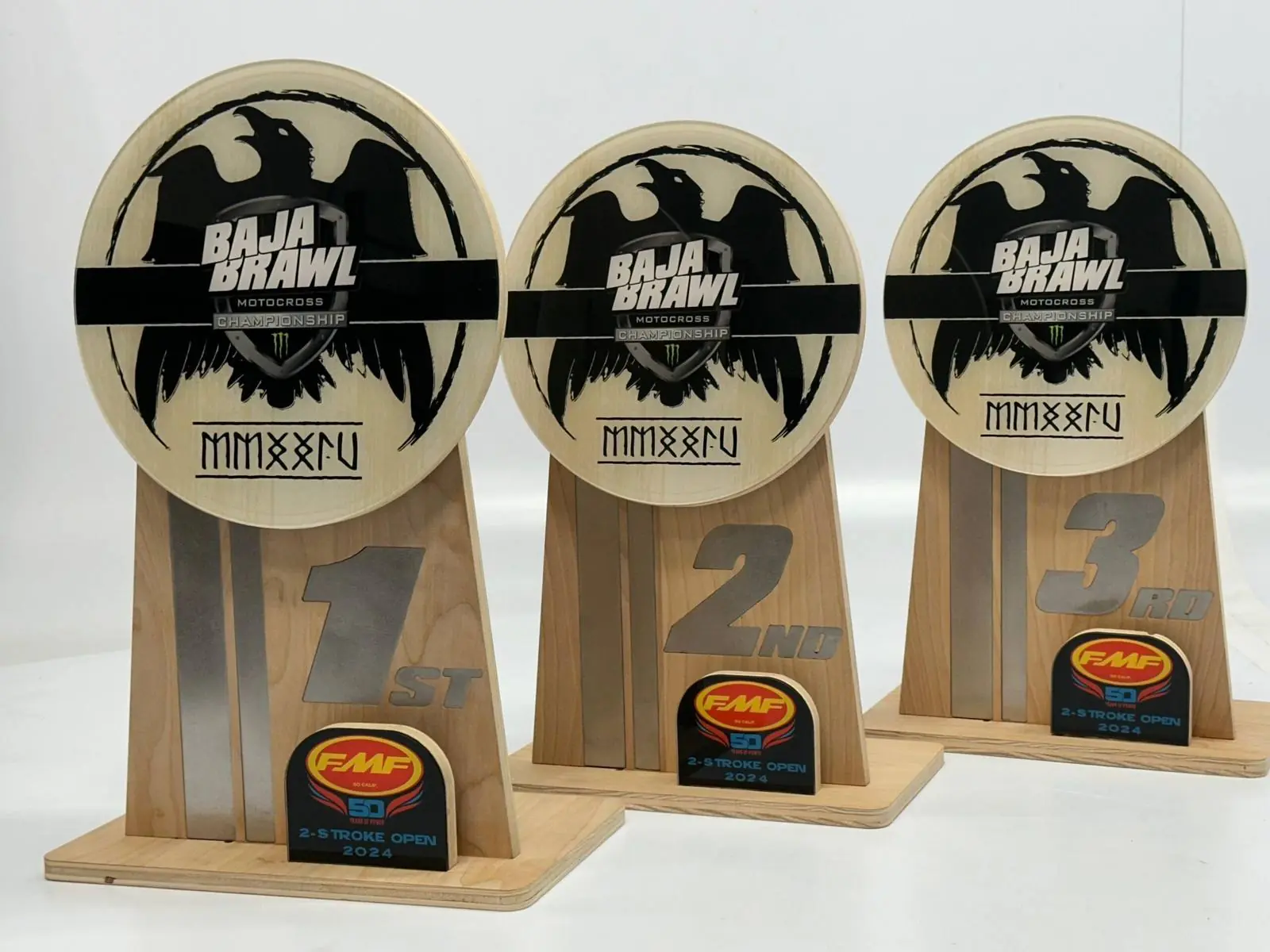
First, second and third place awards on wood bases with printed acrylic faces and cut metal numerals

Written for the decision, not for the search engine

Most trophy content online is a product catalogue with paragraphs around it. These are not that. Each guide takes one decision a buyer actually has to make, sets out the trade-off honestly — including where our own products are the wrong answer — and stops when the decision is made.

They are written from the production side. We cut, print, engrave and assemble the awards ourselves, so the guidance on what a material will and will not do, and on which artwork reproduces cleanly, comes from what happens on the shop floor rather than from a supplier catalogue.

Read one, or read the four that apply to your event. Nothing here assumes you have read the others.

Choosing what to order

Custom acrylic award icon

Which material?

Acrylic, metal and wood compared on the four things that actually decide it: what it costs, what it weighs, how it survives a season outdoors, and how it photographs under stage lighting.

Layered award icon

Which decoration method?

Laser engraving, UV printing, sandblasting and chemical etching produce different-looking awards at different prices. Which one your artwork suits is usually decided by whether it needs full colour.

Fully custom award icon

What drives the price?

Material, size, layer count, decoration method and volume, with worked examples. Enough to build a figure you can put in front of a committee before you ask for a quote.

Getting the specification right

Wall plaque icon

How big, and what goes on it?

Event name, class, placing, year and a row of sponsor marks all have to be readable at arm’s length and from the back of a room. Size follows the content, not the other way round.

Pin and commemorative award icon

What artwork do you need from me?

Vector against raster, resolution, colour formats and line weights. This is the single step that removes the most back-and-forth from a proof cycle.

Medallion award icon

How many, and how do they arrive?

Placings times classes, plus specials, spares and the participation tier — then the freight and receiving side of a large order, which is where the quantity arithmetic usually gets tested.

How custom awards are actually made

The longest guide on the site, and the one worth reading if you want to understand why awards are priced the way they are. It follows a job from a drawing through laser cutting, printing, engraving and hand assembly, and explains what changes at each stage between a semi-custom piece and a fully custom build.

It is also the most useful guide to read before approving a proof, because it makes clear which details are fixed once production starts and which can still be changed.

Read how trophies and awards are made →

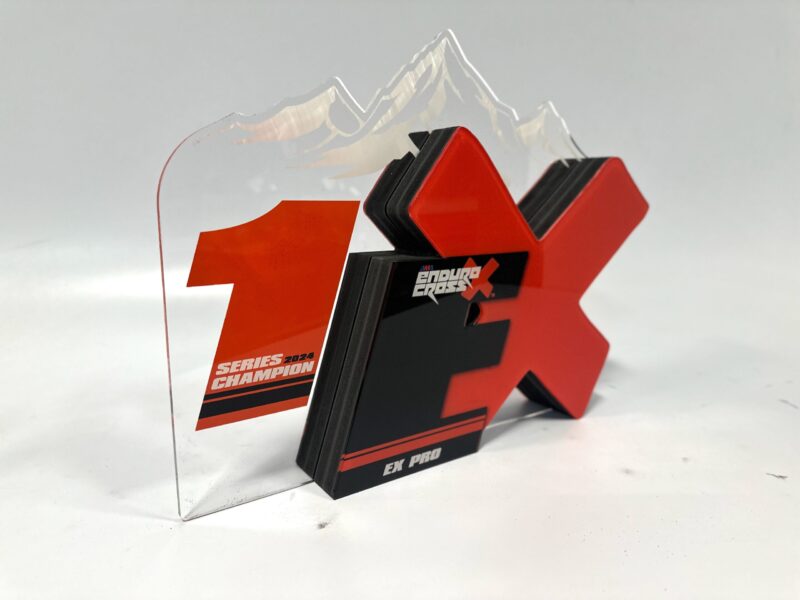
Layered acrylic award with a clear mountain-profile backing plate and a red and black cut-out X

Start with the question you actually have

The guides are written to be entered from the middle. If you know what you need to settle, go straight to it.

The four decisions behind every award order

However the request arrives — a race series, a corporate recognition programme, a one-off presentation — it resolves into the same four decisions. The guides above each take one of them properly; what follows is how they fit together, because the order you make them in matters more than any individual answer.

  • What the award is for. A podium piece, a class family, a participation item and a sponsor thank-you are four different jobs, and an award that tries to do two of them does neither well. This decision sets everything downstream, and it is the one most often skipped.
  • What it is made of. Material is a trade-off between cost, weight, outdoor durability and how the piece reads on camera. It is worth settling before size, because some constructions do not scale the way people expect.
  • How the artwork gets onto it. Printing, engraving and etching are not interchangeable finishes. Full-colour sponsor logos push you towards one; a single-tone recipient name in a wood surface pushes you towards another.
  • How many, and by when. Quantity is arithmetic — placings, classes, specials, spares. The date is not the event date but the date the awards need to be in your hands to be counted and staged, which is normally several days earlier than organizers assume.

Working in that order stops the most expensive kind of rework, which is discovering after a proof is approved that the piece cannot carry everything that has to go on it.

Where the guides stop and a quote starts

These pages are written to get you to a specification you can hand over: a format, a material, a decoration method, a size and a count. What they deliberately do not do is quote a price or a production window for your job, because both depend on the artwork, the layer count and the quantity in ways a guide cannot anticipate.

When you have that specification, request an estimate and we will confirm the current lead time against your event date before anything is designed. If your date is already tight, say so in the first message — that changes which formats are worth discussing.

Guides, product pages and planning

Three different kinds of page on this site answer three different questions, and it is worth knowing which one you want.

  • These guides answer what should we order, and how is it made. They are material- and method-led, and they apply to any event type.
  • The product pages answer what does this specific item cost and what are its options. Every award, plaque, medallion, pin and event item is listed there.
  • Event award planning answers what do we do and when. It is a timeline for an organizer working backwards from a date, and it links to the same guides at the point each one becomes relevant.

If you are planning a car show rather than a race, planning car show awards covers the category structure that discipline uses.

Award Buying Guide FAQs

Which guide should I read first?

If you are pricing an event, start with what drives the cost of custom awards. If you already have a budget and need to choose the piece, start with the material comparison. If you are mid-order and have been asked for artwork, go straight to the logo guide.

What is the difference between a fully custom and a semi-custom award?

A semi-custom award is built on an existing shape with your artwork applied to it, so the design work is limited to the graphics. A fully custom award is drawn from scratch, which allows any outline, layer count or material combination. How trophies are made covers what changes in production between the two.

Does the material change what can be printed on the award?

Yes. Full-colour photographic artwork needs a print process and a surface that suits it, while engraving and etching produce a single-tone mark in the material itself. The decoration guide sets out which combinations work.

How do I work out how many awards to order?

Multiply placings by classes, add special and sponsor awards, add a participation tier if you are running one, then add a small contingency for names that are missed or misspelled. The bulk ordering guide has the full worksheet.

What file format should I send my logo in?

A vector file is always preferred because it can be scaled to any award size without softening. If you only have a raster file, send the largest original you have rather than a version pulled from a website or a social profile.

Do you charge for design work?

No. Design and proofing are included, and nothing goes into production until you have approved a proof. There is no minimum order, so a single presentation piece is as workable as a full season across every class.

Racer in a helmet raising both arms as gold confetti falls under stage lights
READY WHEN YOU ARE

Bring the specification, we will build the proof

Tell us the event name, date, class or category list, quantities and any logo or sponsor artwork. We will come back with a direction and a proof for approval before anything is produced.

Design is included and there is no minimum order, so a single presentation piece is as workable as a full season across every class.