
Plaque Wording Ideas & Examples
What to put on a plaque, trophy or award, with worked examples for every occasion and the checks that save a reprint
Short answer
Good plaque wording has four parts: a title that names the award, the recipient’s name exactly as they use it, one to three lines saying why, and a date line with the name of whoever is presenting it. Keep the message short enough to read at arm’s length, check every name letter by letter, and write the reason specifically rather than generically. The guides below give ready-to-adapt examples for retirement, appreciation, memorial and employee awards, and we lay out the wording for you on a free design proof before anything is produced.
The four parts of plaque wording
Almost every plaque that reads well, whatever the occasion, is built from the same four parts. Writing them separately first makes the whole job easier, because it stops one sentence trying to do three jobs.
- The title. What the award is: Retirement, In Appreciation, Employee of the Year, Series Champion. It is the largest line, and it should stay identical every year if the award repeats.
- The name. Exactly as the person uses it, which is not always how it appears on a roster or a payroll record. Confirm spelling, middle initials and any suffix.
- The message. One to three lines saying why. This is the line people remember, and the one most often left generic.
- The date and the presenter. A year or a full date, plus the organization, team or people it comes from. Years later, this is how anyone knows the context.
How much text fits depends on the size of the piece and the size of the type. The trophy size and layout guide covers that; the short version is that fewer, larger lines always read better than a paragraph.
Wording examples by occasion

Retirement
Formal, warm and forward-looking wording for coworkers, managers, teachers, nurses, first responders and volunteers.

Appreciation and recognition
Thanking volunteers, sponsors, board members, coaches, speakers and business partners, with a fill-in template.

Memorial and dedication
Remembrance plaques, dedications of benches, trees and rooms, and memorial awards presented in someone’s name.

Employee awards
Employee of the month and year, sales, leadership and safety awards, and how to write the reason line.

Years of service
Milestone wording, which years to mark and what to give at each tier.

Perpetual awards
What goes on the award, what goes on each year’s plate, and how many plates to plan for.

Wording for racing and competition awards
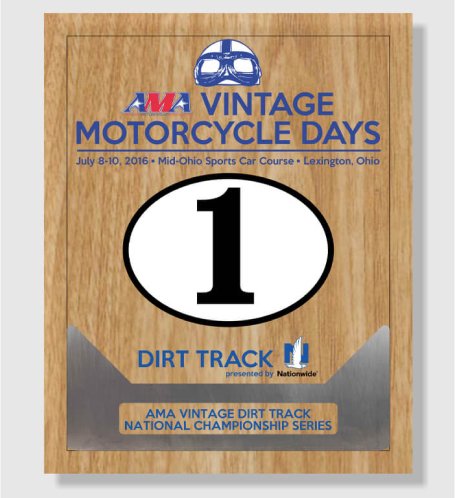
Competition awards follow the same four parts, but the message line is replaced by the result. Racing and series awards usually carry more structured information than any other kind: the event, the round, the class, the placing and the year.
2026 Ridgeline Motocross Series
Round 4 · Summer Nationals
250 Intermediate
1st Place
Season Champion
Open Pro Class
Tri-County Flat Track Association
2026
Two rules keep a class family consistent. Put the event and year in the same place on every award in the set, so the podium photo reads as one design, and put whatever changes between awards (the class and the placing) where it can be swapped without redrawing anything. For points championships, use the championship name, the class and the year rather than a rider’s points total, which is a figure people later argue about.
More on how clubs structure a full set of awards is in motocross trophy ideas by class and placement and planning car show awards.
Seven checks before you approve the proof
Most reprints are caused by the wording, not the production. These checks catch nearly all of them.
- Spell every name letter by letter against a source the person wrote. An email signature beats a spreadsheet, and asking beats both.
- Pick one date format and use it everywhere. June 14, 2026, 6/14/2026 and 2026 are all fine. Mixing them on one set is not.
- Name the achievement, not the job title. Titles change and an award that names one can read oddly within a year. An achievement stays true.
- Keep capitals for the title. A whole plaque set in capitals is harder to read, not more formal.
- Avoid abbreviations only insiders know. Team codes and internal program names mean nothing to the recipient’s family, who are often the people the award is shown to.
- Read it aloud. If a line is awkward to say, it is awkward to read.
- Have someone who did not write it proofread the proof. The author reads what they meant, not what is there.
Writing for a company program? Corporate awards covers what a recurring corporate award should carry and how to keep it consistent year to year.
Plaque Wording FAQs
What should be written on a plaque?
A title naming the award, the recipient’s name, one to three lines saying why they are receiving it, and a date line naming who is presenting it. Those four parts cover almost every occasion, from retirement to a race win.
How many words fit on a plaque?
It depends on the plaque’s size and the size of the type, but fewer, larger lines always read better than a paragraph. As a working rule, a title, a name, a short message of one to three lines and a date is the most a standard wall plaque carries comfortably.
Should a plaque include a quote?
Only if it means something specific to the recipient, and only if you are sure of the wording and who said it. A plain sentence about what the person actually did is usually more personal than a borrowed line.
Is it “in appreciation” or “with appreciation”?
Both are correct. “In appreciation of” is followed by what is being thanked (“In appreciation of 20 years of service”); “with appreciation” or “with gratitude” usually sits above the name and a message.
Can you help write the wording?
Yes. Send what you have, even if it is rough, along with the recipient’s name and any logo. We lay it out and send a design proof for approval before anything is produced, and you can change the wording at that stage.

Send it over and we will lay it out
Send the wording, even if it is rough, with the recipient’s name and any logo. We lay it out on a design proof, and you can change anything before it is produced.
There is no minimum order, so a single plaque is as normal an order as a full set.


