




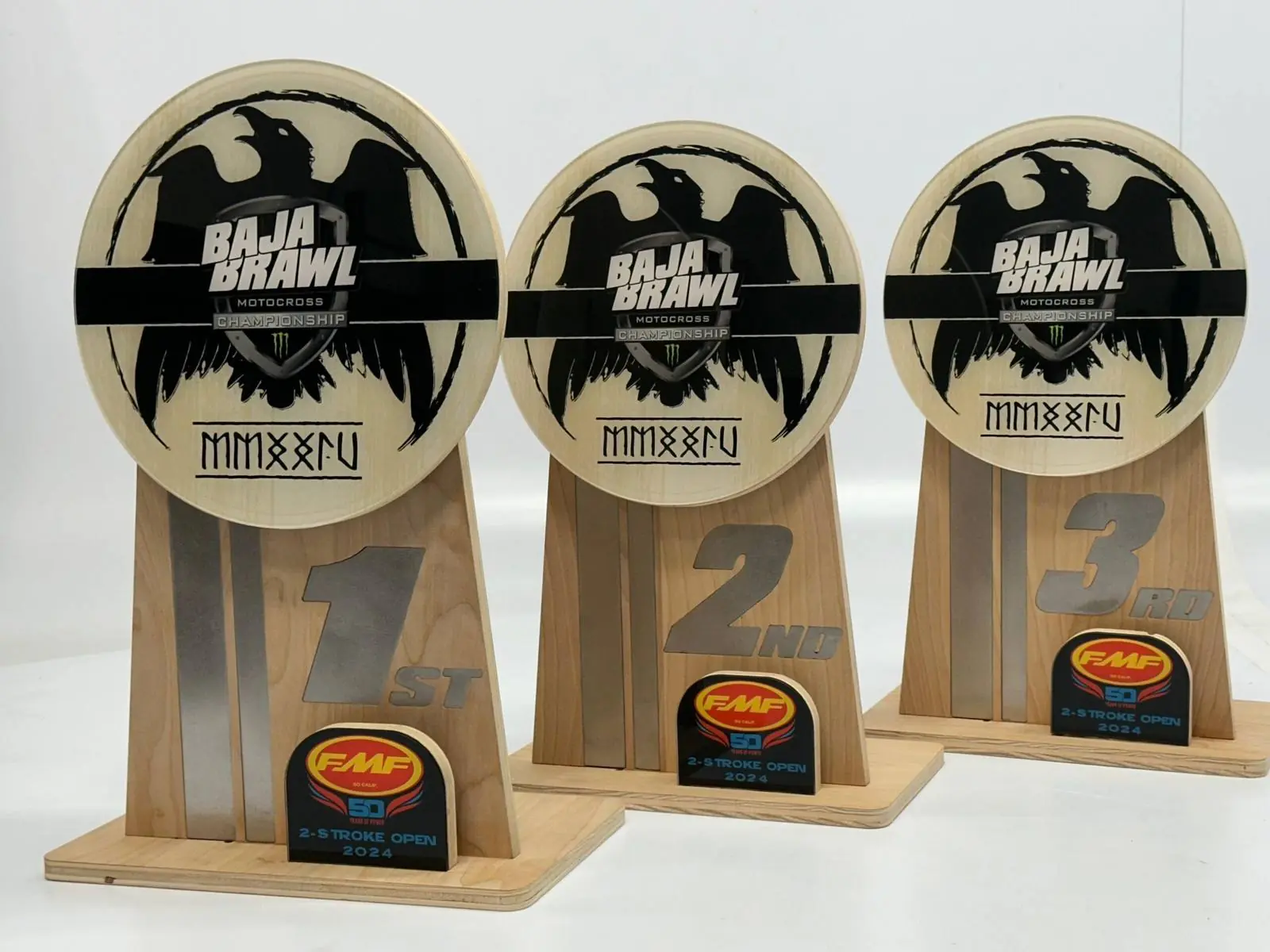
Every banquet order starts with a number, and most of the trouble at the awards table comes from getting it slightly wrong. A class that split mid-season and was counted once. A tie for third that nobody planned for. The flaggers who worked every round and got nothing because they were never on the list.
This guide is a counting method rather than a rule of thumb. You add six lines in the same order every time, check them against your results, then decide on spares. Three worked examples follow: a small club series, a large multi-class series and a youth sports league. The tables show counts only. What each piece costs depends on what you choose, and the price conversation is easier once the count is settled.
The six lines of a banquet count
Write these down as separate lines, not as one running total. When something changes late, and something always does, you need to know which line it belongs to.
- Class awards. Number of classes times the number of places you award in each. This is usually the biggest line and the one most affected by your rulebook.
- Category awards. The awards that are not tied to a finishing position: rookie of the year, most improved, sportsmanship, holeshot leader, hard charger, iron man. Count one per category, or one per class if the category runs in every class.
- Perpetual plates. If the series or club has a perpetual trophy or plaque, each one needs a new name plate this year. These are small, easy to forget and usually needed at the banquet itself.
- Participation pieces. One for every entrant who qualifies, by whatever rule you use: started a minimum number of rounds, finished the series, or simply registered.
- Crew and volunteer thank-yous. Flaggers, scorers, gate, tech, medics, the announcer, the track prep crew, the people who ran registration.
- Sponsor thank-yous. One per sponsor, plus any award a sponsor is presenting on stage, which is counted in line 2 and not here.
Lines 1 and 2 decide the shape of the night. Lines 3 to 6 are where counts go missing. For ideas on what to put in line 2, see racing banquet award categories; for how deep to award in line 1, points championship awards.
Line 1: classes times places
Before you multiply, settle two questions in writing: which classes count, and how deep you award in each.
- Use the final class list, not the entry form. Classes get merged when entries are thin and split when they are full. Count the classes that actually ran for points.
- Decide whether depth varies by class. Many series award the top five in big classes and the top three in small ones. A common rule is to award one place for every few full-season riders, with a minimum of three. Whatever the rule, write it down so nobody argues at the table.
- Decide who is eligible. If a rider must start a minimum number of rounds to be ranked, apply that before counting. A class with nine entries on paper may have five eligible riders.
- Count overall titles separately. An overall champion across classes, or a team or manufacturer title, is its own award, not a second piece for the class winner.
A class with fewer eligible riders than places awarded is common at the end of a season. Award what was earned. An empty spot on the podium is better than a trophy for a rider who started one round.
Lines 2 to 6: the awards that get missed
Category awards grow quietly. Someone suggests a rookie of the year, then someone else wants it per class, and five awards become fifteen. Decide before the banquet whether each category is series-wide or per class, and count it once.
Perpetual plates are usually one or two pieces, but they are the pieces most often left off an order. If a perpetual trophy is presented at the banquet, the plate for this year’s winner needs to be on it or ready to fit. The perpetual trophies guide covers plate planning.
Participation pieces are the largest number on most youth and club orders. A medallion or a trading pin reaches every rider without competing with the podium. Participation awards covers when they work and how to keep them distinct from placings. Count from the entry list, then decide the rule: everyone registered, or everyone who met the minimum rounds.
Crew and volunteers are best counted by role, not by memory. Go through the event roles one at a time and write a name against each. Volunteer awards has options for this line.
Sponsors should be counted from the sponsorship agreements, not from the banner fence. Small in-kind sponsors are the ones that get missed. See sponsor plaques, and sponsor-presented awards if a sponsor is funding a category award.
Worked example: a small club series
A club motocross series with six classes, seven rounds, and about forty riders who met the minimum-rounds rule. The club awards the top three in each class, gives four category awards, keeps one perpetual club champion trophy and hands every qualified rider a medallion.
| Line | How it is counted | Count |
|---|---|---|
| Class awards | 6 classes x top 3 | 18 |
| Category awards | Rookie, most improved, sportsmanship, holeshot leader (series-wide) | 4 |
| Perpetual plate | Club champion trophy, one new plate | 1 |
| Participation | One medallion per qualified rider | 40 |
| Crew and volunteers | Flaggers, scoring, gate, announcer, track prep | 9 |
| Sponsors | One plaque per sponsor | 5 |
| Total before spares | 77 |
Seventy-seven sounds like a lot for a small club, but only twenty-two of those are trophies or plaques. The rest are medallions and thank-you pieces. That is the usual shape of a club banquet, and it is why separating the lines matters: the trophies and the medallions are designed and counted differently.
Worked example: a large multi-class series
A regional series with twenty-four classes from 50cc to the over-50 vet class, ten rounds and a few hundred qualified riders. It awards the top five in classes with ten or more full-season riders and the top three in the rest, names an overall champion in the two premier classes and has three perpetual trophies.
| Line | How it is counted | Count |
|---|---|---|
| Class awards | 14 classes x top 5, plus 10 classes x top 3 | 100 |
| Overall titles | Pro overall and amateur overall champion | 2 |
| Category awards | Rookie of the year per class (24), plus iron man, hard charger, sportsmanship, holeshot leader | 28 |
| Perpetual plates | Three perpetual trophies, one plate each | 3 |
| Participation | One trading pin per qualified rider | 320 |
| Crew and officials | Referees, scoring, flaggers, medics, gate, announcers | 30 |
| Sponsors | Title and presenting sponsors, plus supporting and in-kind | 16 |
| Total before spares | 499 |
At this size the per-class rookie award is the line to question. Twenty-four extra pieces is a real addition, and some series give one rookie of the year in each age group instead. A series this size usually uses one design across every class, changing only the class name and place, which a semi-custom award handles well. Trophy ideas by class and placement shows how to vary the podium pieces within one design.
Worked example: a youth sports league
A youth soccer league with ten teams in four age divisions, about one hundred forty players and twenty coaches. Every player gets a medal, each division crowns a champion and a runner-up, and the league adds an MVP and a coach’s award for each team.
| Line | How it is counted | Count |
|---|---|---|
| Division places | 4 divisions x champion and runner-up team trophies | 8 |
| Player awards | MVP and coach’s award, one each per team | 20 |
| Perpetual plate | League champion plaque, one plate per division | 4 |
| Participation | One medal per player on every roster | 140 |
| Coaches | One thank-you piece per head and assistant coach | 20 |
| Volunteers | Board, referee coordinator, field crew, team parents | 15 |
| Sponsors | One plaque per team sponsor | 10 |
| Total before spares | 217 |
Two decisions change this count more than any other. First, whether champion players also get an individual piece as well as the team trophy; if they do, add the roster sizes of the eight placing teams. Second, whether players who left mid-season still get a medal. Settle both before ordering. Team awards covers matching pieces for every member of a team.
Spares, ties and late changes
Once the six lines are added up, plan for what will go wrong. Something always does.
- Ties. Write the tiebreaker into the rules before the final round: most wins, then most seconds, then the better finish at the last round is a common order. If the rule can still leave a true tie, and you would award both riders, keep one spare at each place in the classes where it could happen.
- Participation spares. Add a few medallions or pins over the qualified count for late registrations, a lost piece and the rider whose name was spelled wrong on the list. Medallions without names on them can simply be kept for next season.
- Named pieces. Anything with a rider’s name on it waits for the final standings. Order the class awards with the class and place on them, and put names on a plate or second line that is finalized once results are official. Ask us how to split the design so the bodies are not waiting on the last round.
- Protests and corrections. If the results can still change after the final round, agree with the series who signs off on the standings, and do not send names until they do.
- Late sponsors and late classes. Keep the line they belong to, add them there, and send the revised count in one message rather than a chain of small changes.
Timing follows from the count. Work back from the date the awards must be in your hands, not the banquet date, and ask us for the current lead time against it. How far in advance to order shows how to work backwards, and bulk ordering awards for events covers larger orders, delivery and keeping the artwork for next year.
Check the count before you send it
- Does the class list match the classes that actually ran for points?
- Is the depth rule written down, and applied the same way in every class?
- Is every category award either series-wide or per class, and counted that way?
- Is every perpetual trophy that will be presented on the list?
- Does the participation count use the same eligibility rule the series announced?
- Has someone gone through the event roles one by one for the crew line?
- Does the sponsor count match the signed sponsorship agreements?
- Are the spares written as their own line, so they are not mistaken for awards?
Send the lines as they are, not just the total. We design the set from them, send a proof you approve before anything is produced, and there is no minimum order, so a short club list is as welcome as a series with every class. More on the whole season-end order is on end-of-season awards.
Frequently Asked Questions
How many places should each class award at a banquet?
Three is the minimum most series use. Larger classes often award five, and some award deeper still. Set a rule based on the number of full-season or eligible riders in each class, write it down, and apply it the same way to every class.
Should every rider or player get an award?
In youth classes and youth leagues, usually yes, and a medallion or pin does the job without competing with the podium. In adult classes, many series give a participation piece only to riders who met the minimum number of rounds.
How many spare awards should we order?
Keep a few participation pieces over the count, and one spare at each place in classes where the tiebreaker could still leave a true tie. Named pieces should not have spares; their names wait for official results.
Do volunteers and sponsors need awards at the banquet?
They need thanks at the banquet, and most series give a piece to each. Count them by role and by signed agreement, not from memory, because they are the lines most often missed.
Is there a minimum order for banquet awards?
No. A club with twenty awards and a series with five hundred are both normal orders, and you approve a design proof before anything is produced.
Have your award list?
Send the count you worked out, line by line, with your logo and the date the awards must be in your hands. We lay out every class on one design proof for you to approve before anything is produced.
See end-of-season awards


