




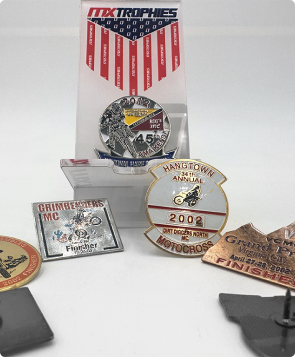
Pins get grouped with trophies because we make both, but they are bought for completely different reasons. Nobody orders four hundred trophies. Clubs order four hundred pins routinely, and almost never as a podium award.
The reason is that a pin does jobs a trophy cannot. It is small enough to give to everyone, cheap enough at volume to give away, durable enough to survive a season on a jacket or a helmet bag, and — the part most people miss — it is the only award anyone actually trades.
What a trading pin is, and why it matters
A trading pin is an event or club pin made in enough quantity that people can give them away. In racing, karting, motocross and club motorsport the convention is simple: you turn up with a stack of your club or team pin, and over the weekend you swap them with people from other clubs. Everyone leaves with a board of pins from events they attended and teams they raced against.
That single habit changes the buying maths completely. A finisher award is one per finisher. A trading pin is however many each person is willing to hand out, which is why club orders run into the hundreds while the club itself might have forty members.
It also changes what the pin has to do. A trophy has to look impressive on a table for one evening. A trading pin has to be worth someone else wanting it — which is a design problem, not a manufacturing one.
The five jobs a pin does that a trophy cannot
Almost every pin order we see is one of these, and most clubs eventually run several at once.
- Trading. The one above. Bought in volume, designed to be wanted, and reordered every season because the year on it changes.
- Club and team identity. A membership pin that says who you ride with. Ordered once, topped up as people join, and the design usually stays fixed for years.
- Sponsor thanks at scale. A sponsor whose contribution does not warrant a trophy should still get something. A run of pins carrying their mark alongside the event name is inexpensive at volume and is genuinely kept.
- Marshals, volunteers and officials. The people who make an event run and are almost never recognised. A year-dated pin is the cheapest meaningful thank-you an organiser can give, and it is worn.
- Finisher and participation awards. Everyone who completed the event, not just the podium. This is the one that overlaps with medallions — see below.
Designing a pin people actually want
A trading pin that nobody wants to trade is just an expensive sticker. The ones that circulate share a few things.
- One idea, big. A pin is roughly an inch across. A club mark, a mascot, a track outline, a number — one of those, filling the shape. Not a logo, a strapline and a sponsor row shrunk to fit.
- A shape, not a circle. The pins people keep are cut to an outline — a bike, a helmet, a track profile, a shield. A round pin with artwork inside it reads as generic even when the artwork is good.
- The year on it. This is the whole engine of trading and reordering. A dated pin is a record of having been there, which is why people keep them and why the club orders again next season.
- Legible at arm’s length. Fine text disappears at this size. If a word has to be read, it needs to be one of the two largest things on the pin.
- A series that builds. Clubs that run a consistent shape and change only the year or the round build something people collect. That is a reordering habit, and it is worth designing for deliberately.
Artwork matters more at this size than on anything else we make, because there is nowhere for detail to hide. The artwork preparation guide covers what to send; the short version is a vector file, and the simpler the mark the better it survives being an inch wide.
How many to order
The most common mistake is ordering one per member. Trading means each person hands out several, so a club of forty that trades will move far more than forty pins across a season.
A workable way to size it: take the number of people who will carry pins, multiply by how many events they attend, and allow a handful per event each. Then add the non-trading uses separately — marshals, sponsors, new members — because those come out of the same box and are always forgotten.
Order the whole season in one run rather than topping up. The artwork is set up once, every pin in the run matches, and a mid-season reorder of a small quantity is the most expensive way to buy pins. Bulk ordering for events covers the same arithmetic for awards generally.
Which finish, briefly
Four production styles are available and they suit different artwork: hard enamel, soft enamel, all-metal die struck, and full-colour offset printing. Which one you want depends mostly on whether your design is flat colour or a photographic image, and how much detail is in it.
Rather than repeat it here, the pin awards page carries a side-by-side comparison of all four on cost, material, printing capability and durability, plus answers to the questions that come up most. If you know which you want, the individual pages are cloisonné, soft enamel, die struck and offset printed.
Pin or medallion for a participation award?
Both reach the whole field at a price that does not compete with the podium budget, and clubs regularly ask which to use.
A medallion on a ribbon is presented — it goes over someone’s head at a ceremony, it photographs well, and it reads as an award. It suits a finish line, a class placing, or anything handed over in front of people.
A pin is carried. It goes on a jacket, a lanyard, a helmet bag or a board on a wall, and it stays visible for years rather than a season. It suits membership, trading, thanking people, and anything where the recipient is not standing on a podium.
Plenty of events run both: medallions for the classes, pins for everyone who turned up.
Frequently Asked Questions
What is a trading pin?
An event or club pin made in enough quantity that people can swap them with other clubs and teams at events. It is a long-standing habit in motorsport and club racing, and it is the main reason pin orders run to several hundred rather than one per member.
How many trading pins should a club order?
More than one per member. Estimate the number of people carrying pins, multiply by the events they attend, and allow several handed out at each. Then add marshals, sponsors and new members separately, because those come out of the same box and are routinely forgotten.
What makes a pin worth trading?
One clear idea filling a cut shape, the year on it, and nothing that needs to be read at small size. Pins cut to an outline — a bike, a helmet, a track profile — circulate far better than a round pin with artwork placed inside it.
Should the year be on a club pin?
On a trading or event pin, yes. The date is what makes it a record of having been there, which is why people keep them and why the club reorders next season. A permanent membership pin is the exception and usually stays undated.
Can we put a sponsor logo on a pin?
Yes, and it is one of the better uses of a pin — a sponsor too small to warrant a trophy still gets something people keep. Give the sponsor mark real space rather than shrinking it into a corner, because anything small enough to be an afterthought will not reproduce at this size.
Is there a minimum order on pins?
No. A single commemorative pin is a normal order, though the per-unit price drops considerably with volume, which is why club and series orders are usually placed as one run for the whole season.
Ready to design your club or event pin?
Send us your club or event artwork and roughly how many you need, and we will come back with a finish recommendation and a proof.
See pin awards


