




Powerboat racing has an identity problem that no land discipline shares: the competitor is not really a person, it is a boat. Crews change, owners change, and the thing spectators follow across a season is a hull with a name and a number on it.
Awards that treat the driver as the subject therefore miss what people are actually attached to. Seven ideas built from how powerboat racing is run, crewed and presented.
1. The boat name belongs above the driver name
This is the inversion that makes a powerboat award look like it was designed by somebody who has been to a race. The hull name is the identity — it is on the deck, it is what the commentator says, it is what the sponsor paid for.
Put the boat name in the largest line on the plate and the crew names beneath it. Owners notice immediately, and an award laid out that way is far more likely to end up somewhere it gets seen.
2. Driver and throttleman, two awards
In the classes that run two up, the throttleman is not a passenger. They are managing power against water conditions the driver is not looking at, and the crew is scored as a unit precisely because both jobs decide the result.
One trophy for a two-person crew creates a question with no good answer. Two awards on the same design, both named to the role, costs a fraction more and settles it.
3. One family, the class on a plate
Classes here come from hull type, engine and length, and a race weekend usually runs several of them off one course. Design the award once and put the class and placing on a separate printed plate.
It keeps a multi-class weekend looking like one event, and it means a class with four boats costs the same per award as the one with twenty. Only quantity scales.
4. The hull profile as the shape
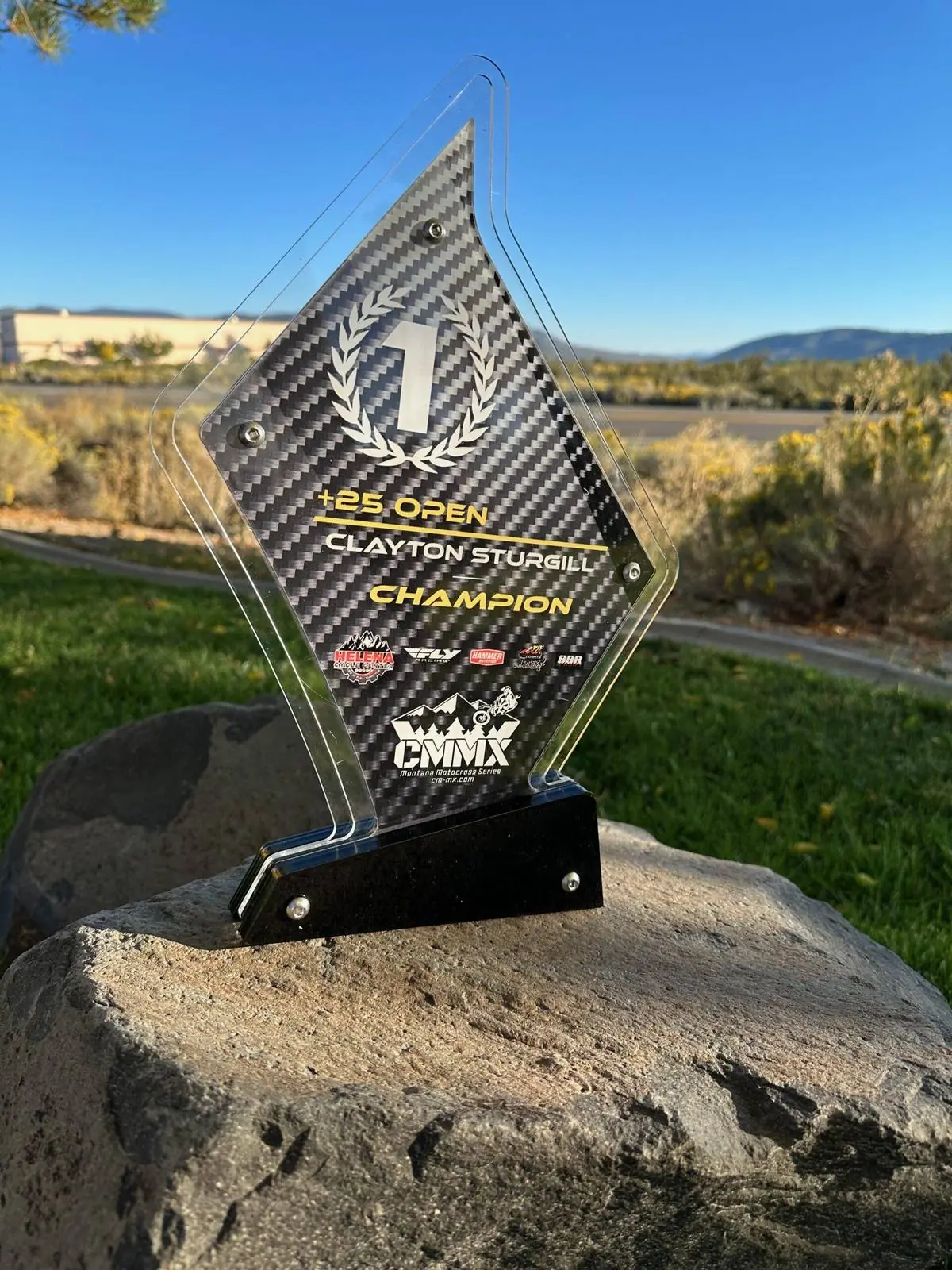
A racing hull in profile is one of the most recognisable silhouettes in motorsport and almost no award uses it. A catamaran and a deep-vee do not look remotely alike, which means the shape can carry the class without a word.
Cut in layered acrylic it reads well from the side, which is how an award sits on a shelf. It also gives a series a straightforward way to make each class visibly its own while staying one family.
5. Design for a presentation on a dock
Powerboat awards are handed over outdoors, near water, frequently in wind, to people in wet gear. That is a harder environment than most trophies are designed for.
Weight helps here rather than hurting — a piece with enough mass to sit still on a dock table is worth more than a taller one that blows over during the photographs. Strong contrast matters too, because these presentations happen in full daylight.
6. A season perpetual the club holds
Boats outlast crews in this sport, and a perpetual is the natural way to record that. One substantial award, a plate added each season with the boat name and the year, handed back before the next.
Because the boat is the constant, a powerboat perpetual reads as a genuine history in a way a driver-named one does not. Build it with plenty of blank plates.
7. The safety boats and the course crew
A powerboat race cannot legally run without rescue craft on station and a crew setting and holding the course. They are on the water all day and they are never in the results.
A small run of awards in the same family, presented at the same ceremony, is the least expensive part of the order and it is why those crews come back next season.
Putting it together for a weekend
One design family built on the hull profile, the boat name leading the plate, doubles for two-up crews, a perpetual carrying the boat names and something for the safety crews. That is a full programme in one artwork approval.
Send the entry list with the boat names spelled as the owners spell them. That is the single detail most often wrong on a powerboat award, and it is the one people notice.
These ideas are for a race weekend. For the awards a club gives at the end of the year, see boat racing season awards; for drag and closed-course racing, drag boat racing trophies and hydroplane and outboard racing trophies.
Frequently Asked Questions
Should the boat name or the driver name be larger on the plate?
The boat name, in almost every case. It is the identity the sponsor, the commentator and the spectators follow, and crews change around it. Driver and throttleman names sit beneath it.
Do awards need to handle being presented next to the water?
Yes, and mass is what does it. A piece heavy enough to stay put on a dock table in wind photographs far better than a taller, lighter one, and printed acrylic and wood builds handle the damp without trouble.
Can one design cover catamarans and deep-vee classes?
It can, and the neat version uses the hull profile itself to differentiate: same family, same artwork, a different cut per class, with the class named on the plate.
Ready to design your powerboat racing awards?
Send us your class structure and the boats entered and we will build a direction for the whole weekend before anything goes into production.
See powerboat racing trophies


