




An employee recognition program is a set of decisions made once, written down, and then repeated: what the organization recognizes, who decides, how often, and what the person receives. Without those decisions, recognition depends on which managers happen to be good at it. With them, it reaches everyone.
We make the awards at the end of this process, so this guide is written from the awards side of the table. It sets out the decisions in the order that works, and where a question belongs to your HR, legal or accounting team, it says so.
What a recognition program is, and is not
A program is the structure: the categories, the calendar, the rules and the awards. It is not the software. Recognition platforms, points systems and reward catalogs are tools some organizations use to run a program, and they are a separate purchase from a separate kind of company. We do not sell them, and a program does not need one to work. Plenty of long-running programs are run from a spreadsheet and a calendar reminder.
It is also not a substitute for pay, workload or management. Recognition works on top of those things. It cannot repair them.
Step 1: Decide what the program is for
Write one sentence that begins “We are doing this so that…”. Common answers: so that good work in every department is seen; so that long service is marked properly; so that our values mean something in practice; so that people who work safely know it is noticed.
The sentence matters because it settles later arguments. If the purpose is to make less visible work seen, a program that hands every award to the sales team has failed, however well it was run.
Step 2: Decide what gets recognized
Most programs recognize some mix of four things:
- Results: targets met, projects delivered, customers kept.
- Behavior: how the work was done, usually tied to the organization’s values.
- Service: years with the organization, and retirement.
- Milestones: safety records, qualifications earned, a first year completed.
Turn the mix into a short list of named categories, each with a written criterion. Employee award categories and names gives the full menu. Fewer categories, clearly defined, are better than many that overlap.
Step 3: Decide who nominates and who decides
| Method | Strength | Watch for |
|---|---|---|
| Manager decides | Fast, and the manager knows the work. | Depends heavily on the individual manager. |
| Peer nomination | Sees what managers miss; trusted by the team. | Can favor the best-known people. |
| Panel or committee | Consistent and easier to defend. | Slower; the panel needs members from across the business. |
| Measured result | Objective, such as a sales figure or a service date. | Only suits categories that can be measured fairly. |
Most programs combine them: nominations from anyone, a panel to decide, and measured results for service and sales. Peer-to-peer recognition covers coworker nominations, and how to write an award nomination is worth sharing with nominators.
Write down the eligibility rules at the same time: who can be nominated, whether someone can win twice in a row, whether managers are eligible for the same awards as their teams, and how part-time and contract staff are treated. Your HR team should approve these.
Step 4: Build the tiers
A program that consists only of one annual award is too rare to change anything. One that consists only of daily thanks has nothing to look forward to. Programs that last have layers, and each layer has a different weight.
| Tier | How often | What it looks like |
|---|---|---|
| Everyday thanks | Whenever it is earned | A specific thank-you, a note, a message to the person’s manager. No approval needed. |
| Spot recognition | Several times a year | A small award or token a manager can give on the day, for something notable. |
| Periodic awards | Monthly or quarterly | Employee of the month or quarter, team awards, safety milestones. |
| Annual and career awards | Once a year, or once in a career | Employee of the year, leadership awards, years of service, retirement. |
Detail for each tier: employee recognition ideas for the first two, how to run an employee of the month program for the third, and years of service awards and employee of the year awards for the fourth.
The awards themselves should show the difference. If the monthly award and the annual award look identical, the annual one has been devalued. Size, construction and material are how an award says how much it means.
Step 5: Set the calendar
Put every recurring date in a calendar owned by a named person, with a deputy: nomination deadlines, decision meetings, presentation dates, and the date awards need to be requested so that they arrive in good time. Programs rarely fail from lack of goodwill. They fail because the one person who ran them changed jobs and nothing was written down.
Fixed dates in the year help. Many organizations anchor their program to Employee Appreciation Day in March, a year-end event, or both. The workplace recognition calendar lists the dates worth knowing.
Step 6: Set the budget
We will not suggest a figure, because the right one depends on the size of the organization, the number of tiers and what else the budget has to cover. What we can say is how to think about it.
- Budget by tier, not as one pot. Decide what a spot award, a periodic award and an annual award should each cost, then multiply by how many of each the year will need.
- Count service awards separately. Their number is known in advance from hire dates, so they can be planned precisely.
- Spend more per piece as the tiers rise. The top tier is few in number and kept for life.
- Include the presentation. The event, the time and the shipping to other sites are part of the cost.
- Ask about tax treatment. How awards and gifts are treated for tax purposes varies with the kind of award. That is a question for your accounting team, not for an awards maker.
Corporate awards has a section on what a full recognition program costs and what drives it, and another on who usually signs off an order.
Step 7: Choose the awards
By this point the awards almost specify themselves: you know the categories, the tiers, the quantities and where the pieces will end up. A few principles hold for almost any program.
- One family of designs. Awards across the tiers should look related, so that the program has an identity.
- The reason on the piece. Name, award, date and a line saying why. An award with no reason on it is a souvenir.
- Think about where it will live. A desk, a wall, a shelf at home, a hard hat. That decides the form.
- Plan to repeat. A design that can be reordered keeps the award identical from year to year, with only the name and date changing.
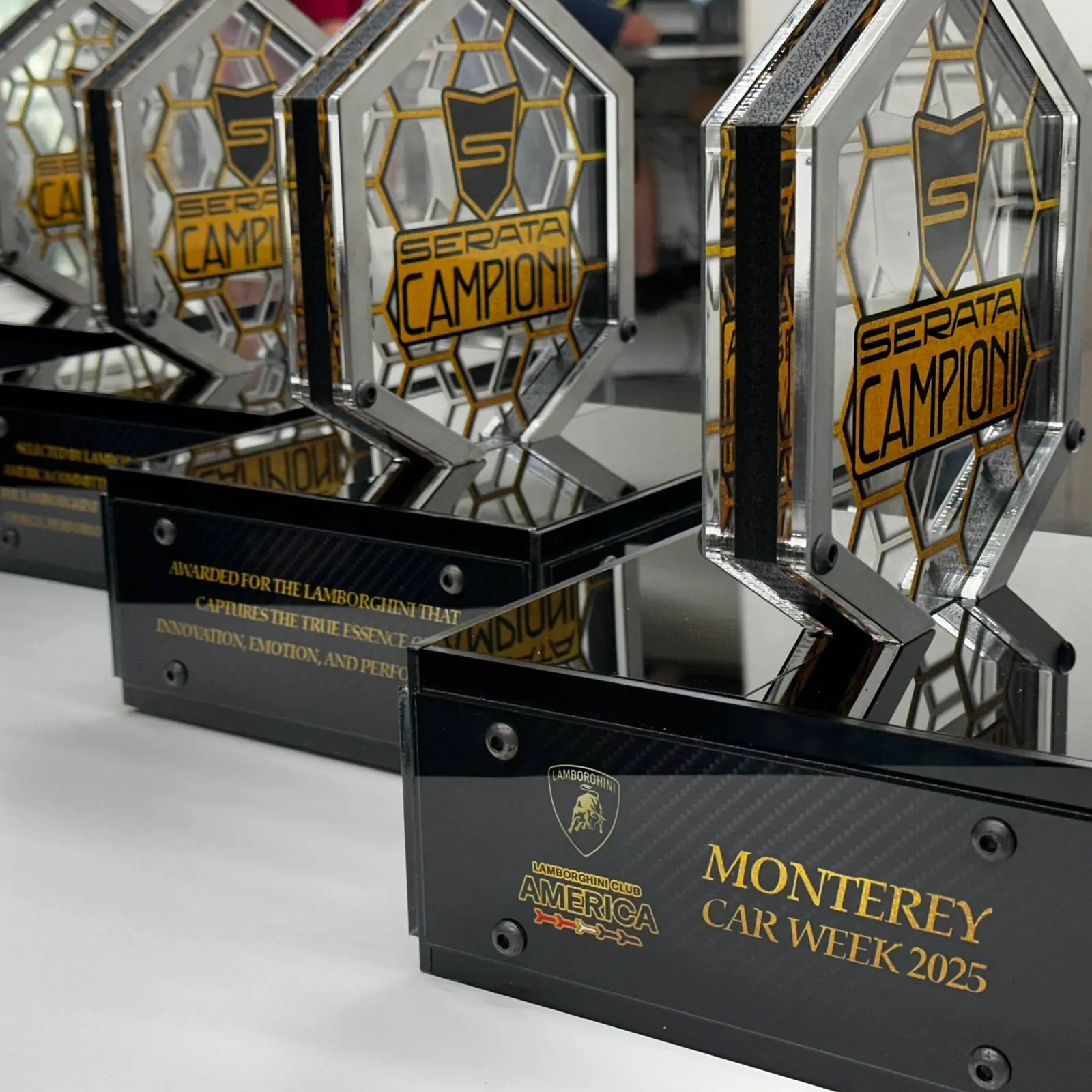
We build in acrylic, wood and metal: custom-shaped layered acrylic printed in full color, wood plaques, semi-custom awards for larger quantities, pins, and perpetual plaques with metal name plates. We do not sell glass or crystal. There is no minimum order, every order starts with a design proof, and we ship nationwide, including to several locations. Employee recognition awards shows the range, and employee award wording covers what to write.
Step 8: Tell people, then keep telling them
A program nobody understands produces no nominations. At launch, explain what is recognized, how to nominate and when awards are presented, in one page. Then, every cycle, publish who won and why. The “why” is the most important communication a program has: it shows everyone else what good looks like.
Present awards properly. A named presenter, a few specific sentences and a photograph take five minutes and are what the recipient remembers. See how to present an award. For people who are not on site, see awards for remote and hybrid teams.
Step 9: Keep it fair, and review it
Once a year, look at the list of everyone recognized and ask plain questions. Did every department appear? Every site and every shift? Every level? Did the same few names recur? Were some categories never awarded because nobody was nominated? The answers tell you which criteria to rewrite and which teams need a prompt.
- Keep the criteria and the names stable. Change the rules as little as possible; consistency is where a program’s credibility comes from.
- Do not skip a cycle. A missed month tells people the program is optional.
- Keep records. Past winners, the wording used and the award design, so that a new organizer can pick it up.
- Ask the recipients. A short conversation with last year’s winners will tell you whether the moment landed.
Corporate awards also covers keeping a program consistent from year to year, including reordering the same design.
Frequently Asked Questions
What is an employee recognition program?
A written, repeatable structure for recognizing employees: what is recognized, who decides, how often, and what the person receives. It usually has several tiers, from everyday thanks to annual awards.
How do you start an employee recognition program?
Decide what the program is for, choose a short list of categories with written criteria, decide who nominates and who chooses, set the tiers and the calendar, agree a budget by tier, then choose the awards and tell everyone how it works.
Do we need recognition software?
No. Software can help large organizations administer a program, but it is a separate decision. Many programs run for years on a spreadsheet, a calendar and a named owner. We make awards and do not sell software.
How much should a recognition program cost?
It depends on the size of the organization and the number of tiers. Budget by tier and by quantity rather than as a single figure, and ask your accounting team how awards are treated for tax purposes.
Why do recognition programs fail?
Usually because the criteria were vague, the same people kept winning, or the one person who ran it moved on and nothing was written down. A named owner, a calendar and an annual fairness review prevent most failures.
Need the awards as well as the plan?
Once the program is planned, send us the award names, quantities and locations. We will design the set and send a proof before anything is produced.
See employee recognition awards


