




Every convention in employee recognition assumes a room. Someone reads a name, the recipient walks to the front, there is applause, and a photograph gets taken. Take the room away and most of the value of the moment goes with it — which is why recognition in distributed companies so often quietly degrades into a gift card and a message in a channel.
An award still works when the recipient is at home. It just has to be designed for the way it will actually arrive: alone, in a box, with nobody watching. That changes the piece, the packaging and the timing, and almost nothing about the budget.
What actually changes when nobody is in the room
Three things, and they are worth being explicit about because each one has a fix.
- There is no moment. The award arrives on a Tuesday between meetings. Without deliberate staging it is a parcel, not a recognition.
- Nobody else sees it. In an office, an award on a desk is seen by fifty colleagues for years. At home it is seen by the recipient and their family, which is a different audience and changes what should be on it.
- It has to survive a courier. An award handed over at a dinner never leaves the building. One sent to forty home addresses gets handled by three carriers and dropped at least once.
Design for a desk, not a stage
Stage awards are built to read from the back of a room: tall, imposing, legible at ten metres. None of that helps on a home desk, where the piece is seen from half a metre and shares space with a monitor and a mug.
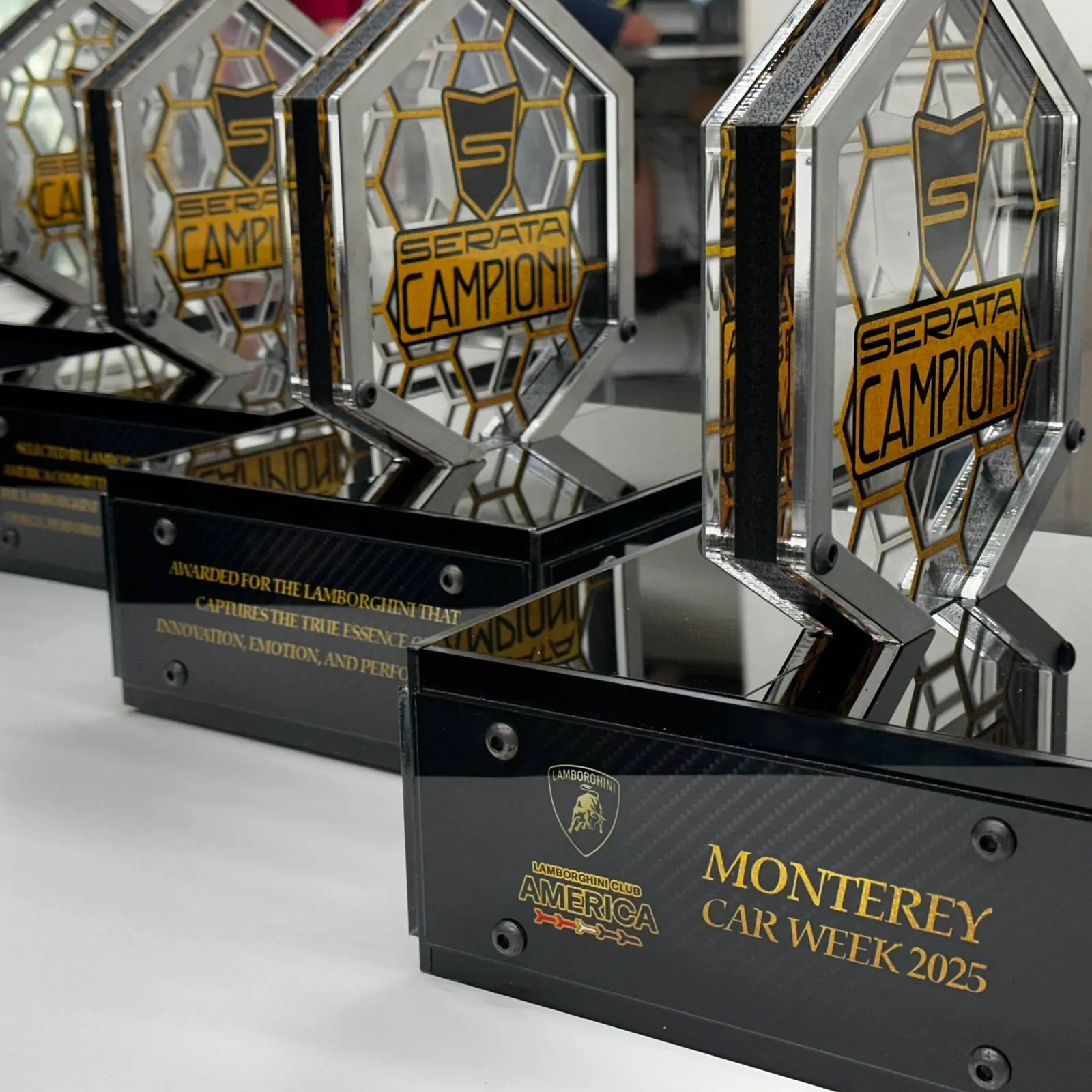
Smaller and better made beats larger. At close range the finish is what carries it — clean edges, a properly registered print, a base that sits flat. Those are the things a recipient notices when the award is eighteen inches from their face every day, and the things nobody sees from a stage.
It also has to survive being on a shelf in a home rather than a lobby. Choosing between acrylic, metal and wood covers how each behaves; the short version for this use is that weight reads as quality in the hand, and acrylic keeps colour where sunlight from a window would fade a printed label.
Put the reason on the award
This is the single biggest change from an in-person programme, and the one most often missed.
At a ceremony, the citation is spoken. Someone explains what the person did, everyone hears it, and the award itself only needs a name and a category. Ship that same award to a home address and the citation never happens — the recipient gets an object that says "Excellence Award 2026" and no record of why.
So put the reason on the piece. Not a paragraph, but enough that it means something in five years: the specific achievement, the year, and the name of whoever it is from. The size and layout guide covers fitting that much text without crowding it.
Ship to homes properly
The logistics are the part that catches programmes out, and they are entirely solvable if they are planned rather than discovered.
- Collect addresses early and privately. This is the longest lead item in the whole programme, not the awards. HR usually has to ask each recipient individually, and people are slow to answer a message they do not understand the purpose of.
- Ask before you ship a surprise. A home delivery that needs a signature and arrives while someone is out becomes a trip to a depot, which is the opposite of being made to feel valued.
- Specify packaging as part of the order. An award boxed for a pallet to one office is not boxed for forty individual courier journeys.
- Plan for the ones that go wrong. Across any real list, something is undeliverable or arrives damaged. Order a small contingency in the same run so the replacement matches.
Rebuild the moment on purpose
Shipping the award is not the recognition. The recognition is somebody saying what the person did, and that still has to happen — it just has to be scheduled rather than assumed.
What works: have everyone open theirs at the same point in a call, so there is a shared moment rather than forty private ones. Have the citation read out loud, by a person, not posted as text. And send the piece to arrive a day or two BEFORE the call rather than after, so the reveal is the event.
What does not work: shipping first and mentioning it in a channel afterwards. The award becomes a receipt for a decision made elsewhere.
What to give people who are only sometimes in the office
Hybrid teams are the awkward middle, because half the programme can be presented and half cannot, and running two different awards makes the remote half look like an afterthought.
The straightforward answer is to run one format for everyone and present it wherever the person happens to be — in the room for those who are there, shipped for those who are not, with the citation read out in both cases. One design, one order, one setup.
A smaller carried piece works well alongside it for teams that gather rarely: a pin or a medallion reaches everyone at a cost that does not compete with the main award, and it travels to whatever office someone next walks into.
Frequently Asked Questions
Do awards still work for remote employees?
Yes, but the design has to change. A stage award is built to read from the back of a room; a shipped award is seen from half a metre on a desk. Smaller and better finished beats larger, and the citation has to be on the piece rather than spoken.
Can you ship awards to individual home addresses?
Yes. Specify it as part of the order so the packaging suits individual courier journeys rather than a single pallet to one office, and collect the address list early — gathering addresses is usually the longest lead item in the whole programme.
What should be engraved on an award for someone working remotely?
The specific achievement, the year, and who it is from — not just a category name. At an in-person ceremony the reason is spoken aloud; shipped to a home it never is, so the award has to carry it.
Should everyone open their award at the same time?
It works far better than shipping and mentioning it afterwards. Send the pieces to arrive before a scheduled call, have people open them together, and have the citation read out by a person. The award is the prompt for the moment, not a substitute for it.
How do you handle a hybrid team fairly?
Run one format for everyone and present it wherever each person is, reading the citation in both cases. Two different awards for the same recognition makes the remote half look like an afterthought.
Is there a minimum order?
No. A single award shipped to one home address is a normal order, and so is a programme reaching a whole distributed workforce.
Planning a recognition programme?
Tell us how many people the programme reaches and roughly where they are, and we will work out the format and the delivery together.
See corporate awards


