




Supermoto is the only discipline that asks a rider to do two contradictory things on one lap. Tarmac for most of it, then a dirt section that has to be attacked completely differently, then back onto asphalt with a front wheel that has just been sliding.
That contradiction is the thing worth putting on the award, and almost nobody does. Most supermoto trophies are road-race trophies with a different sticker on them. Seven ideas that come out of how the discipline is actually run — usually by a small club, on a kart circuit, with a dirt chicane built for the weekend.
1. One design, the class on a plate
The cheapest idea here and the one that makes the rest affordable. Design the award once — the circuit, the year, the club mark — and put the class and placing on a separate printed base plate. S1, S2, mini, veterans, clubman: same piece, different plate.
Supermoto grids are small and the class list is long, which is the worst possible combination for per-design costs. Because the shape is laser-cut and the graphics printed rather than moulded, one artwork approval covers every class you run, and the only thing that scales with the entry list is quantity.
It also makes a two-day meeting sortable. Plates let the box be packed in presentation order before it leaves the workshop.
2. Both surfaces in one object
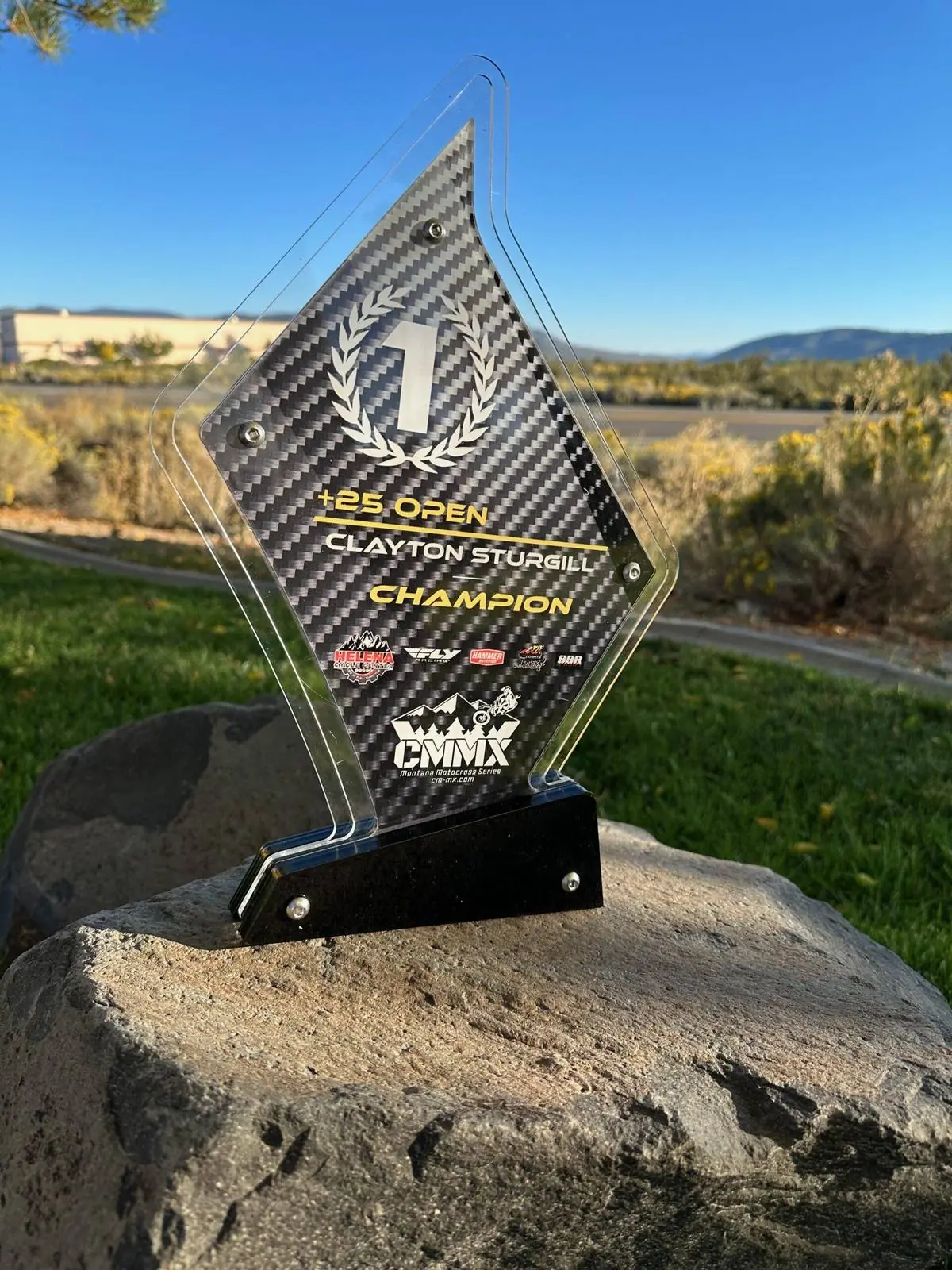
A supermoto award has an obvious material story that no other discipline can use: two surfaces, joined. A dark textured panel for the dirt against a smooth gloss panel for the tarmac, split across the face of the award, says what the sport is without a word of explanation.
Layered acrylic does this well because the two halves can genuinely be different materials at different depths rather than two colours printed flat. The seam between them is the award, and the seam is the sport.
3. The dirt section as the shape
Every supermoto circuit is a kart track for most of the year. What makes it supermoto for one weekend is the dirt section somebody built — the jump, the chicane, the loose loop through the infield.
Cutting that section into the award captures the only part of the layout that belongs to your event rather than to the venue. It also gives a club a reason for this year to look different from last year while staying the same family, because the dirt section usually moves.
4. An award for the sliding boot
The steel-shod boot dragging through a corner is the single image supermoto is known for, and it is a shape almost no trophy uses. As a silhouette it is instantly readable and completely specific — nothing else in motorsport looks like it.
It works best as the special rather than the podium piece: hardest charger, ride of the day, best save. Riders keep the odd-shaped one.
5. Best on tarmac, best on dirt
Because the lap has two halves, the timing already exists to award them separately if the club wants to. Fastest through the dirt section is a genuinely different skill from fastest on the asphalt, and it is often a different rider.
Two specials on the same design family cost very little and they double the number of people who go home with something. On a small grid that matters more than it does anywhere else on this list.
6. Something for the circuit that lends you the track
Supermoto usually happens on somebody else's kart circuit, and the relationship with that venue is what decides whether the club has a calendar next year. Marshals, the circuit staff, the person who let you dig a hole in their infield and trusted you to fill it in.
One award at the end of the season, in the same family as the race trophies, costs almost nothing and is remembered considerably longer than a podium piece.
7. The mini and youth classes on the same family
Supermoto is one of the few disciplines where a mini class runs the same layout as the adults, on the same day, with the dirt section unchanged. That is unusual and it is worth reflecting in the awards.
Give the youth classes the same design at a smaller scale rather than a visibly cheaper object. A rider who wins a mini class and then wins a clubman class three years later should be able to put the two on the same shelf and see the relationship.
Putting it together for a round
One design family, the class on a plate, the dirt section in the shape, a couple of surface-specific specials and something for the circuit. That is a full supermoto programme and it is one artwork approval.
Send the class list in the wording it will appear in on the day, including how you abbreviate the classes. That single thing prevents most of what goes wrong at the presentation.
Frequently Asked Questions
Does a small supermoto club pay more per award than a big meeting?
Per unit, no. The design is approved once and the class and placing sit on a printed plate, so a club running eight classes off a forty-rider entry pays the same per award as a national round. Quantity is the only thing that scales.
Will an award with two different surfaces cost more to make?
Not meaningfully. A layered build with a textured panel and a gloss panel is the same process as any other layered acrylic award — the materials differ, the production does not.
Can we match this year's awards next season if the dirt section moves?
Yes, and that is usually the point. We keep the approved layout on file, so a new season changes the year and the cut of the dirt section and leaves the rest of the family alone.
Ready to design your supermoto awards?
Send us your class structure and the circuit you are running and we will build a direction for the whole round before anything goes into production.
See supermoto trophies


