




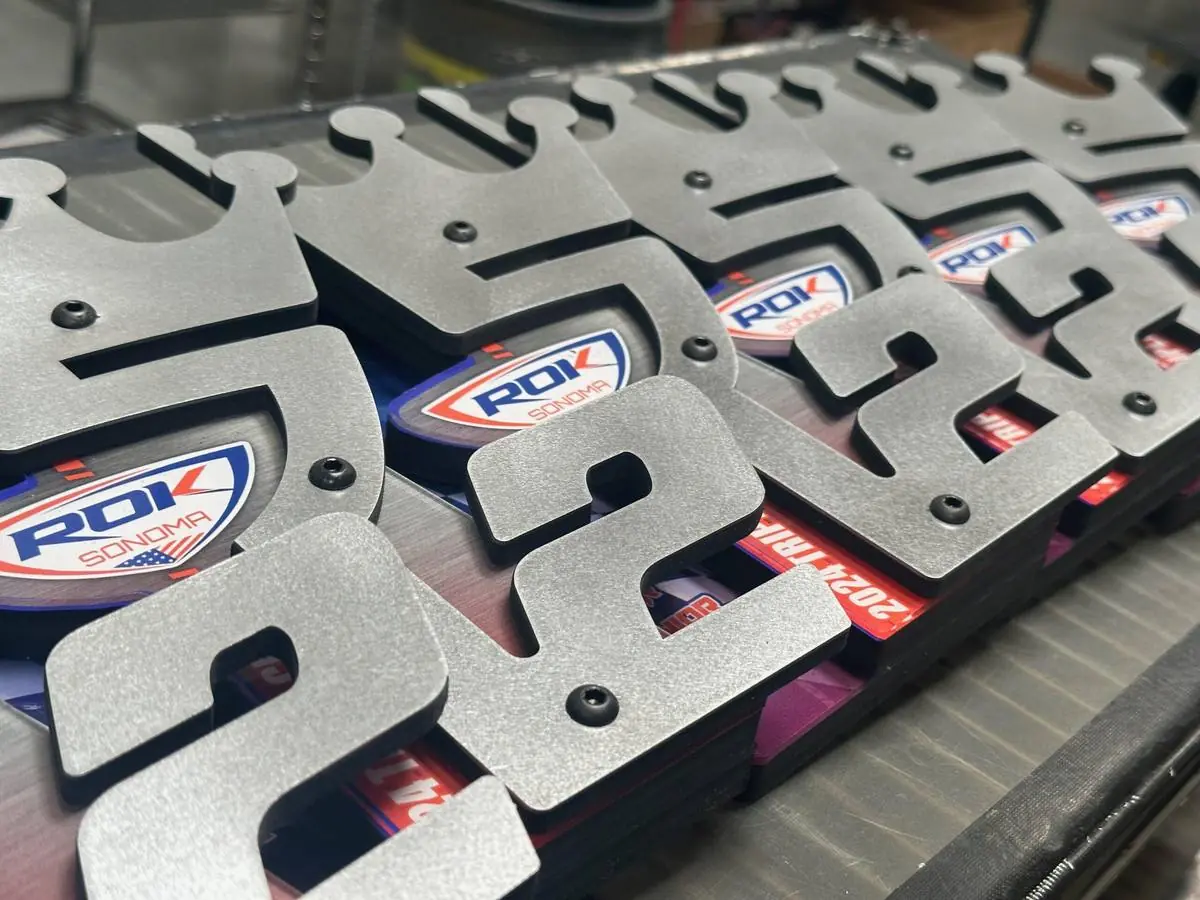
RC club racing has a structure almost nothing else shares: it runs every week, most of the year, for the same forty or fifty people, and a single night produces qualifying results, several heats and multiple finals.
That means volume and repetition are the whole problem. An award programme designed around one annual prizegiving misses fifty race nights. Seven ideas built from how a club season actually runs.
1. The B and C mains are somebody's final
Almost every RC meeting sorts its field into an A, B and sometimes C main, and only the A main usually gets an award. But the B main is a genuine final for the drivers in it, contested exactly as hard.
Awarding the lower mains costs very little — they are the same design with a different line on the plate — and it roughly triples the number of people who leave a meeting with something. In a club that depends on weekly turnout, that is the entire point.
2. Something repeatable for a weekly night
A club racing forty nights a year cannot hand out a substantial trophy every week, but handing out nothing for forty weeks and one trophy in November wastes the format's biggest advantage.
A small, repeatable piece — the same design all season with the date and class on the plate — turns a race night into something collectable. Drivers end up with a row of them, which is a stronger record of a season than a single trophy.
3. TQ is its own achievement
Top qualifier is decided on pure single-lap and consistency pace with no traffic, and it frequently goes to a different driver from the one who wins the main. Clubs that award it find it is treated as seriously as the win.
It is also the cheapest way to add a second name to a night: one more plate, same design.
4. One family, the class on a plate
Scale, drivetrain and motor split an RC entry list finely — touring, buggy, short course, stock and modified all run the same evening on the same track.
Design once, put the class on a printed plate, and a club running eight classes stays a single artwork approval. A class with five entrants costs the same per award as the one with thirty.
5. The drivers standing on the rostrum corners
RC racing is close to unique in making competitors marshal each other's races — the drivers who just raced go out and turn cars over for the next heat. The meeting does not function without it.
A marshalling award at the end of a season, for the person who never missed a call, recognises the thing every club quietly struggles to enforce. It costs the same as any other award and it changes behaviour.
6. Season points and the club champion
The points title across a whole season is the hardest thing to win at a club and it deserves an object of a different order from the weekly pieces.
A perpetual with a plate added each season works particularly well here, because RC clubs run for decades with a stable membership and the list of past champions is genuinely interesting to the people reading it.
7. The beginner class, taken seriously
Most clubs run an entry-level or box-stock class, and it is where every future member starts. It is also the class most likely to be given the leftovers.
Same family, same materials, smaller scale. A driver who moves from box-stock to modified over two seasons should be able to put both awards on the same shelf.
Putting it together for a season
One design family, class and date on the plate, awards down to the B and C mains, a TQ piece, something small and repeatable every week and a perpetual for the champion. That covers a whole season in one artwork approval.
Send the class list and an honest count of race nights. The weekly pieces are the volume item and they are what makes the rest of the order economic.
Frequently Asked Questions
Is it worth awarding the B and C mains?
For a club that needs weekly turnout, yes. They are the same design with a different line on the plate, so the cost is small, and they roughly triple the number of drivers who leave with something.
What works as a weekly award that will not get expensive?
A small repeatable piece in the season design, with the date and class on the plate. Approved once, produced in one batch for the year, and issued week by week — drivers collect a row of them across a season.
Can one design cover eight classes?
Yes, and it should. The class sits on a printed plate rather than in the artwork, so the design is approved once and a five-entrant class costs the same per award as a thirty-entrant one.
Ready to design your RC racing awards?
Send us your class list and season calendar and we will build a direction that covers weekly nights and the end-of-season meeting before anything is produced.
See RC racing trophies


