




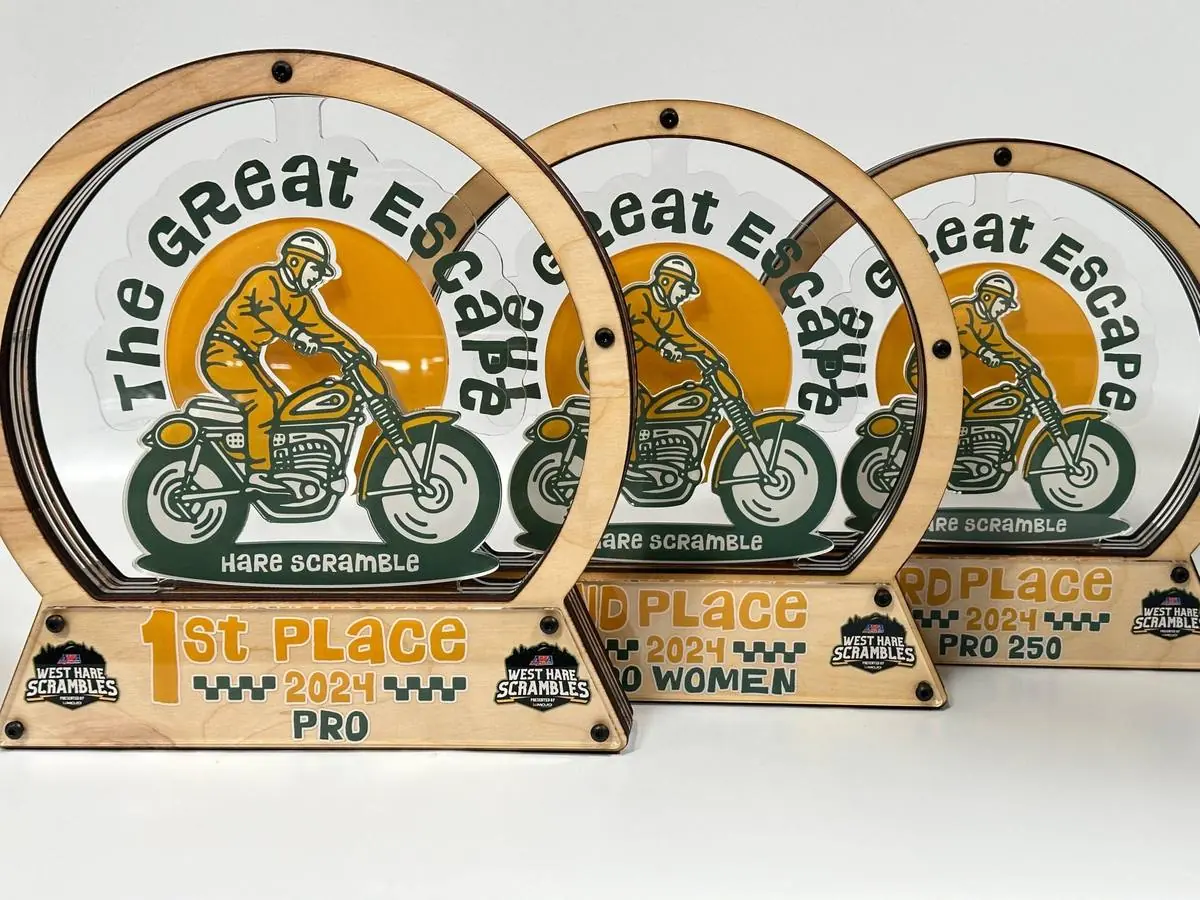
Personal watercraft racing runs two sports off one entry list. There is closed-course buoy racing, scored over motos like any motorsport, and there is freeride and freestyle, which is judged like gymnastics. Many events run both on the same weekend.
An awards programme that treats them identically undersells one of them, usually the judged one. Seven ideas built from how PWC events are actually structured and presented.
1. Ski and runabout are not the same race
Standing on a ski and sitting on a runabout are different sports with different bodies, different techniques and largely different competitors. Sharing an award design is right; sharing a class line is not.
One family, the hull type and class on the printed plate. It is the cheapest way to make a rider in a small stand-up class feel like they are at the same event as the runabout field rather than beside it.
2. Freestyle is judged, and the award should look it
A freestyle result comes from a panel scoring difficulty and execution, not from a stopwatch. That is a genuinely different achievement and the sport treats it as the marquee discipline.
Give it a distinct shape within the family — something with more vertical presence, since the entire event is about air. A freestyle award that looks like a closed-course award with different text on it reads as second billing.
3. One design, the class on a plate
PWC class lists are long: hull type, engine, skill grade and age all divide the field, and a regional round can carry twenty categories off a modest entry.
Design the award once and let the plate carry the class. A category with five riders then costs the same per award as one with fifty, which is what makes running the small classes viable at all.
4. The buoy as the design language
A closed course is defined by its buoys, and the buoy is a simple, instantly readable shape that belongs to no other discipline this company works with.
As a frame for the whole family it works well — the buoy as the silhouette, the class on the plate inside it, the venue and year in the artwork. It also photographs cleanly, which matters for an event that lives on social video.
5. Moto scoring means the overall winner may not have won a moto
Because results are aggregated across motos, consistency beats a single win, and the rider who takes the class often did not top any individual race. That is worth recognising rather than hiding.
A moto win award alongside the class overall gives two riders something and reflects how the format actually works. It costs one more plate.
6. Salt water, and a presentation on the sand
These events finish on a beach or a ramp, in full sun, with competitors soaked and salty. Awards are handled wet more often here than anywhere else on this site.
That argues for robust, high-contrast pieces without fine detail or delicate joins, and against anything that needs to stay pristine to look right. It also argues for a shape that can be set down on sand.
7. The youth and novice classes underneath
Youth PWC classes are where the sport replaces itself, and they usually run early in the day when the crowd is thin. A lesser award compounds that.
Same family, smaller scale, same materials. A novice rider who moves up two grades in three seasons should be able to line the awards up and see one progression.
Putting it together for an event
One design family framed on the buoy, hull type and class on the plate, a distinct freestyle piece, a moto win award and the youth classes on the same family. That covers both sports in one artwork approval.
Send the class list as it appears in your supplementary regulations, including how you abbreviate hull types. That is the notation most often corrected late.
For the boat classes that often share the same water, see power boat racing trophies and the rest of boating event awards.
Frequently Asked Questions
Should freestyle awards be bigger than closed-course awards?
Different rather than bigger. A distinct shape in the same family recognises that it is judged rather than timed, without implying the closed-course classes are a support programme.
How do we handle twenty classes on a small entry list?
Put the class on a printed plate and approve the design once. A five-rider class then costs the same per award as a fifty-rider one, so the small categories stop being the reason to cut the class list.
Will awards survive a wet, salty presentation on a beach?
Yes. Printed acrylic and wood builds are handled wet at these events routinely. The things to avoid are fine detail and delicate joins, not the environment itself.
Ready to design your jet ski racing awards?
Send us your class structure and race format and we will build a direction that covers the closed course and the freestyle card before anything is produced.
See jet ski racing trophies


