




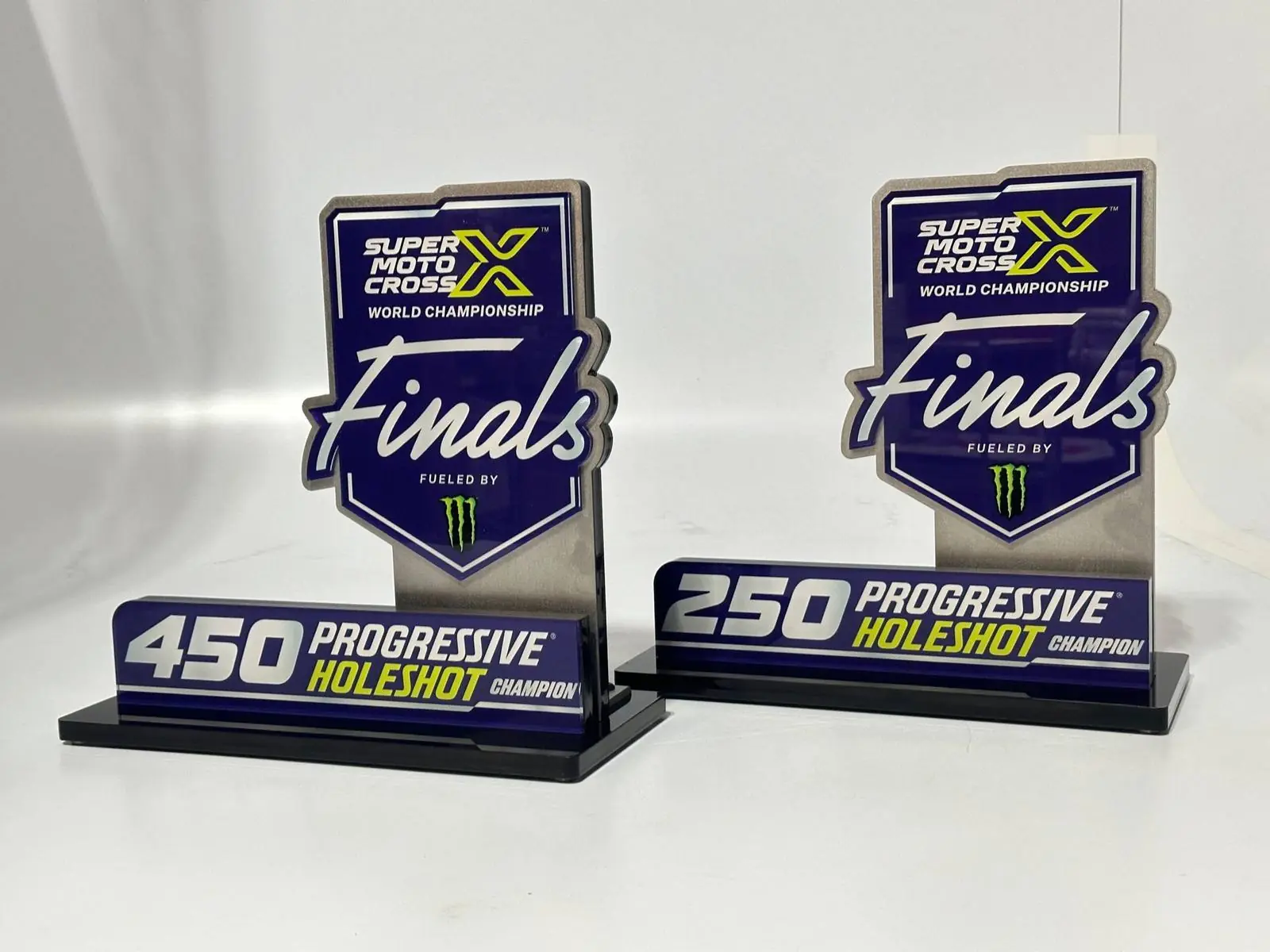
A supercross night settles more than the main event. Heats, a last chance qualifier, a holeshot, sometimes an amateur programme in the afternoon — and all of it presented on one podium, in front of a stadium, minutes after the last chequered flag.
The events that do awards well here are not spending more than the ones that do it badly. They pick one idea, build a family around it, and let the class plate do the differentiating. Seven of those ideas, all of them things we have actually made for racing clubs and promoters.
1. One design that covers the whole race card
The most useful idea on this list and the cheapest to execute. Design one award — the round artwork, the year, the series mark — and put the result on a separate base plate. Heat winner, LCQ winner, main event first, second, third: same piece, different plate.
It works because the artwork is set up once and only the plate text changes, so a dozen awards across a night cost far less than a dozen individual designs. On the presentation table it reads as one round rather than four unrelated orders.
It also solves the thing that actually goes wrong at a supercross presentation, which is not a broken award but the right rider being handed the wrong one. Plates make the box sortable before it leaves the truck.
2. The holeshot award, built as its own object
A holeshot recognises something a podium does not: being first out of a gate with twenty other riders in it. When the award is a smaller version of the main event trophy, that distinction disappears in the photograph.
Give it its own shape. A gate, a start straight, a wide low piece rather than a tall one — anything that reads as a different award at a glance. Sponsors like it for the same reason: a holeshot award is almost always the one with a title sponsor on it, and a distinct shape gives that sponsor something of its own rather than a smaller share of the podium piece.
3. The starting gate, in layers
The gate is the one piece of scenery every supercross round has and no other discipline does. As a layered acrylic build it works particularly well, because a gate is literally a row of parallel elements — the shape wants to be cut in layers.
Put the clear layer in front with the round name second-surface printed on it, the gate cut behind, and the depth does the rest. It photographs with more presence than a flat piece without adding the weight of a solid award a rider has to hold overhead.
4. The track, as the round drew it
Every supercross track is built for that weekend and torn out on Monday, which makes the layout genuinely specific to the round in a way a permanent circuit never is. Cutting the season's track map into the award captures something the rider cannot get anywhere else.
It also gives a series a reason for round two to look different from round one while staying obviously the same family — same frame, same colours, different shape inside it.
5. A season perpetual that travels round to round
A perpetual is the cheapest way to make a series feel like a series. One substantial award, name plates added each round or each season, handed back before the next one. The plates cost very little; the object accumulates meaning that no single-round trophy can.
Build it with more blank plates than you think you need. A perpetual that runs out of room in year four has to be replaced, and a replacement perpetual is not the same object.
6. Specials that are not places
Hard charger, privateer of the night, best mechanic, first-timer. These cost the same as any other award and they are the ones people are most surprised to receive, which is usually what makes them the ones that get photographed.
They are also the awards a sponsor can attach to most naturally, because a special is a story rather than a result.
7. The amateur programme underneath
If your round carries an amateur or futures day, that is where the volume is: more classes, younger riders, and families who have travelled for it. The structure that works is a medallion or small plate for the field and trophies at the top of each class, on the same design family as the pro night.
Riders who race the amateur day and then watch the main event see the same award twice, at two scales. That is worth more than a separate, cheaper-looking programme.
Putting it together for a round
One design family, the result on a plate, the holeshot as its own piece, a perpetual for the series and a couple of specials. That is a full programme and it is one artwork approval.
Send the class structure in the wording it will appear in on the night. That single thing prevents most of what goes wrong.
Frequently Asked Questions
Should the holeshot award match the podium trophies?
It should sit in the same family — same colours, same artwork — but not be the same shape. A holeshot recognises a different thing from a win, and in photographs a smaller copy of the podium piece just reads as fourth place.
How many awards does a supercross night actually need?
It depends on whether you award heats and an LCQ as well as the main. A one-class night with podium only is three; a full card with heat winners, an LCQ and specials is nearer a dozen. Work from the schedule rather than the entry list.
Can round two match round one later in the season?
Yes. We keep the approved layout on file, so a later round changes the date and round name and nothing else. That is also what makes a mid-season addition straightforward.
Ready to design your supercross awards?
Send us your round dates and class structure and we will build a direction for the whole race card before anything goes into production.
See supercross trophies


