




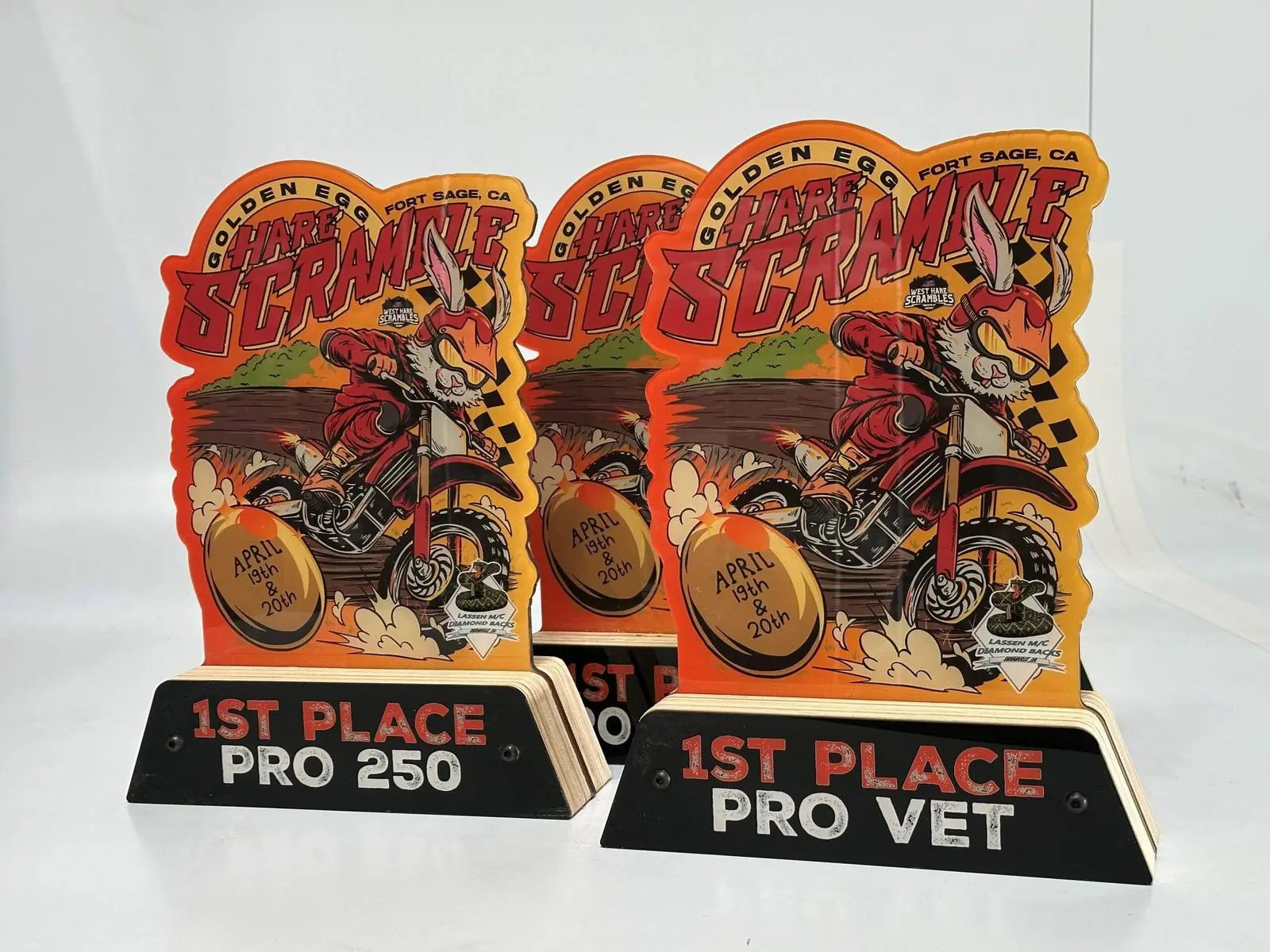
Road racing has a problem no other discipline has quite so badly: the grid is enormous and the classes are granular. A single club weekend can run Superbike, Supersport, Twins, Vintage, Lightweight and a novice group, each with three places, plus specials — and the awards budget has to stretch across all of it without every piece looking identical.
The events that solve it well do not spend more. They pick one strong idea, build a family around it, and let the class name do the differentiating. What follows is seven of those ideas, all of them things we have actually made for racing clubs.
1. One shape, a different class plate on every base
The single most useful idea on this list, and the cheapest to execute. Design one award — the event artwork, the year, the club mark — and put the class and placing on a separate base plate. Superbike, Supersport, Twins and Vintage all get the same piece with a different plate.
It works because the artwork is set up once and only the plate text changes, so twenty awards across six classes cost far less than twenty individual designs. And on the table it reads as one event rather than six unrelated orders.
This is what the awards at the top of this page are: one shaped acrylic face, one wood base, and a plate reading the class and the place.
2. The circuit outline
Every road racing venue has a shape people recognise instantly, and riders who have raced it know it in their hands. Cutting the award to the circuit outline — or putting the outline behind the artwork as a layer — gives you a piece that is unmistakably about that track.
It travels well across a season too. A series visiting five circuits can run the same design with a different outline at each round, which is the sort of thing people start collecting.
Layered acrylic suits this best, because the outline can sit on a separate layer behind the text and still read cleanly. Acrylic plaque awards covers the construction.
3. Number-plate awards
A racing number board is already an award-shaped object: a bold outline, one enormous number, high contrast, readable at speed. Building the award to that shape with the winner’s own race number on it produces something extremely personal without any custom design work per rider.
It is a strong choice for a season championship, where the number is the identity, and for club events where riders keep the same number all year.
4. Layered lean-angle silhouettes
A bike at full lean is one of the most recognisable shapes in motorsport, and it works as a cut silhouette rather than a printed image. Two or three acrylic layers — rider silhouette in front, track or horizon behind — give real depth under the light at a presentation.
Keep the silhouette generic rather than trying to match a specific machine. A recognisable riding position reads better at award size than an attempt at a particular fairing, and it means one design serves every class.
Semi-custom awards are usually the right route for this: the layered build already exists and your artwork goes onto it.
5. A championship perpetual that comes back every year
A season championship deserves something different from a race win, and the strongest version is a perpetual: one substantial award that stays with the club, with a plate added for each year’s champion. The rider gets a smaller keeper piece to take home.
It is the only award on this list that gets more valuable over time, and it costs the club almost nothing after the first year — just a plate. Clubs that run one usually find it becomes the thing riders actually chase.
Order the keeper pieces in the same run as the class awards so they match, and specify the perpetual with enough blank plate space for a decade rather than a season. More in perpetual trophies.
6. Specials that are not places
Road racing generates achievements the podium does not capture, and they are cheap to recognise because the quantities are tiny.
- Lap record. The one award that is genuinely rare, and worth making properly when it happens.
- Hard charger. Most places gained from the grid — the award that recognises a ride rather than a result.
- First podium. A rider’s first ever trophy is the one they photograph and keep forever.
- Best privateer. The rider running on their own money against factory-backed entries.
- Sportsmanship. Usually voted by riders, and usually the award that gets the loudest applause.
Two or three of these per season adds very little to the order and gives the presentation a shape beyond reading out placings.
7. Something for the riders who are not on the podium
A road racing grid is mostly not the podium. Track-day graduates, first-season novices, riders who finished every round of a championship — these are the people whose continued entries fund the club, and they typically receive nothing.
A medallion on a ribbon, or a year-dated pin, reaches the whole field at a cost that does not compete with the podium budget. Pins in particular get worn on jackets and traded between clubs, which keeps the event visible long after the weekend.
For how to size a participation tier against the podium order, bulk ordering awards for events has the arithmetic.
Putting it together for a season
The clubs that get the most from an awards budget decide three things early: one design family for every class award, two or three specials, and one participation piece that reaches everyone. Then they order the whole season in one run so the artwork is set up once and round five matches round one.
For formats, sizes and what each construction costs, motorcycle road racing trophies and awards has the options and pricing. If you are still choosing between materials, the award buying guides compare them properly.
Frequently Asked Questions
How many trophies does a road racing weekend need?
Multiply the number of classes by the places you award, then add specials and any participation tier. Road racing catches people out because the class list is longer than it looks — a club weekend running six classes with three places each is eighteen awards before a single special is added.
How do you keep costs down across a lot of classes?
Use one design for every class award and put the class and placing on a separate base plate. The artwork is set up once, only the plate text changes, and the awards still read as one coherent event on the table.
What is a perpetual award and is it worth it?
One substantial award that stays with the club, with a plate added for each year’s champion, while the champion takes home a smaller keeper piece. After the first year it costs only a plate, and it tends to become the award riders actually compete for.
Should the circuit be on the award?
It is one of the strongest ideas available to road racing, because the outline is instantly recognisable to anyone who has raced there. It works as a cut shape or as a layer behind the artwork, and a series can run the same design with a different circuit at each round.
What should we give riders who do not finish on the podium?
A medallion on a ribbon or a year-dated pin reaches the whole field at a cost that does not compete with the podium budget. Pins get worn and traded between clubs, which keeps the event visible well beyond the weekend.
Is there a minimum order for club awards?
No. A single lap-record award is a normal order, and so is a full season across every class.
Ready to design your road racing awards?
Send us your class list and round dates and we will build a direction for the whole season before anything goes into production.
See road racing trophies


