




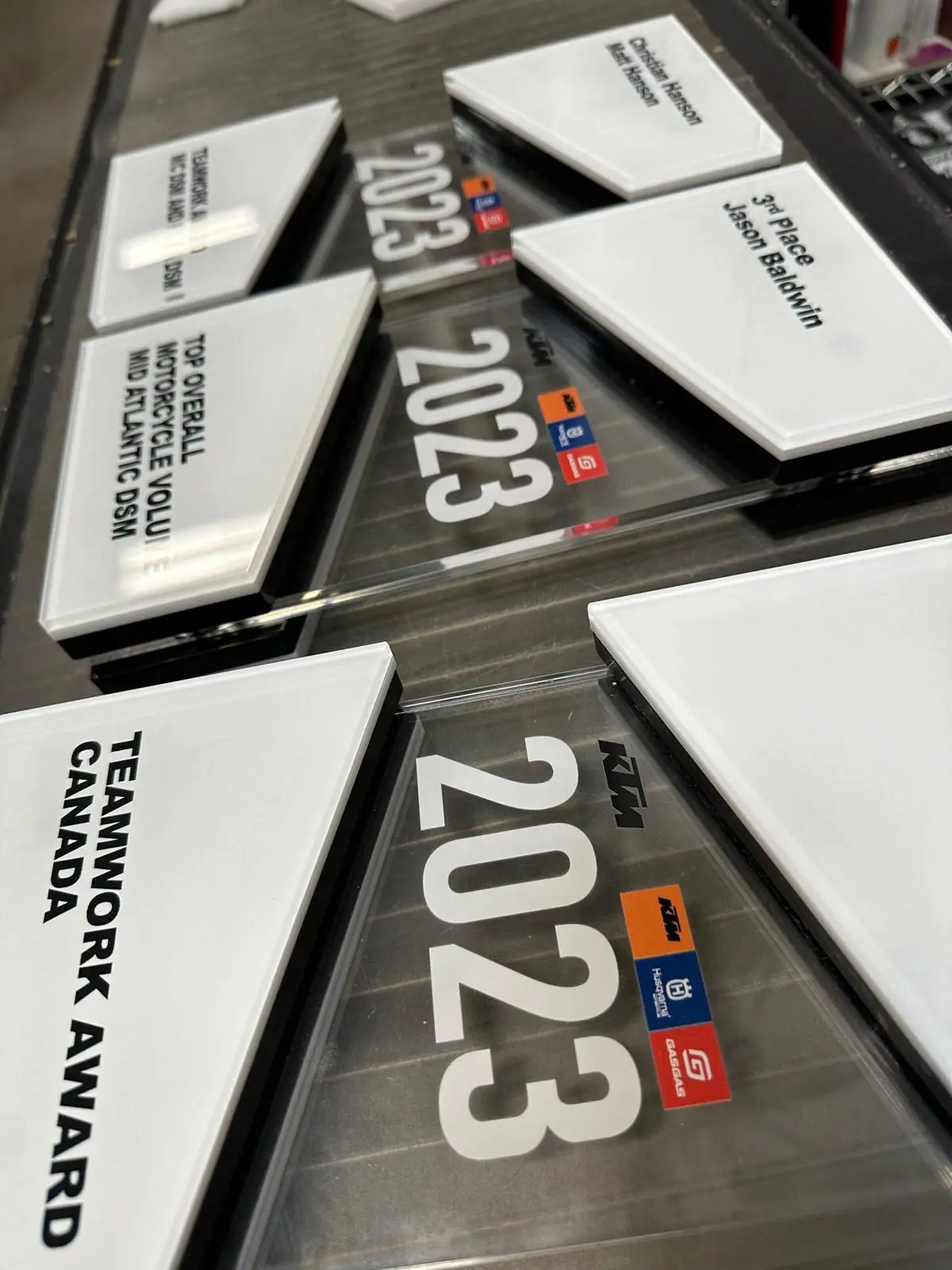
An arenacross weekend awards more classes than almost any event of its size. The pro card is short. The amateur day underneath it is not — thirty or more classes is normal, across two race days, in a building booked for the weekend.
That makes the class list the order. Almost every decision worth making follows from it, and none of them is about spending more. Seven ideas that come out of running a long list rather than a big one.
1. One design family, thirty class plates
Design the award once — venue artwork, year, series mark — and put the class and placing on a separate printed base plate. Thirty classes then cost thirty plates rather than thirty designs.
The economics matter here more than anywhere else on this list. Because the shape is laser-cut and the graphics printed rather than moulded, a thirty-class programme costs the same per unit as a five-class one. The only thing that scales is quantity.
The awards at the top of this page are exactly that: one family, laid out flat, every plate a different class and placing.
2. Put the race day on the plate, not in the design
Saturday and Sunday in the same arena is two presentations and two sets of results out of one order. The neat version is one design with the day printed on the base plate, packed and labelled as two boxes.
It reads as one weekend rather than two unrelated events, and it means nothing has to be unpacked and re-sorted between days — which on a two-day programme is where the mistakes come from.
3. The number-one plate for series champions
A plate-shaped award is the shape a motocross rider has spent the whole season looking at, and as an end-of-series trophy it lands harder than a generic cup. Cut it as the plate outline, print the number large, put the class underneath.
It works best as the layered version of the design the round winners received, so the champion piece is visibly the same family one level up.
4. Layer the pro classes, keep the amateur classes single
One design, two builds. The headline classes get the multi-layer version with raised elements; the amateur classes get the same artwork as a single layer. Same event, same look, budget where it shows.
This is a better use of money than making the amateur awards smaller. A smaller award reads as a lesser award; a flatter one just reads as the same award.
5. The building, not the sport
Every arenacross round happens somewhere specific, and the venue is usually the thing riders and families actually remember about it. An arena silhouette, or the roofline, or just the venue name set as the dominant element gives the award a sense of place that a generic bike graphic does not.
It also gives a promoter running the same weekend annually an obvious way to change the year without redesigning the award.
6. Awards a five-year-old can carry
The 50cc and 65cc classes are the ones where the award is most likely to be dropped, waved, slept with and put in a car boot next to a bike. That is a design constraint, not a joke.
What survives it: mass in the base, no thin projections, no sharp corners on the face, and the class printed large enough that a parent can find the right one in a box of thirty.
7. The people who ran the weekend
Track crew, flaggers, gate staff, the people who build the track on Thursday and take it out on Monday. A handful of plaques on the same design as the race awards costs almost nothing against the rest of the order.
On a programme this size the volunteers are the reason it runs at all, and they are the ones most likely to come back next year.
Putting it together for a weekend
One design family, class and day on the plate, layered for the pro classes, number-one plates for the champions, and a small set for the crew. One artwork approval covers all of it.
The class list is the work. Send it in its final wording and we will proof every plate against it before anything is cut.
Frequently Asked Questions
We award more than thirty classes. Does that get expensive?
Not in the way people expect. The design is approved once and the class list drives the plates, so cost scales with quantity rather than complexity. Thirty classes is a normal arenacross order, not an unusual one.
Can we add a class after approving the proof?
Usually. Adding a class to an existing design is a plate change rather than a new design, which makes it the least disruptive kind of late change. Tell us as early as you can and we will confirm what is still open.
Should Saturday and Sunday have different awards?
Different plates, same design. It keeps the weekend reading as one event and lets us pack and label each day separately so nothing has to be re-sorted in the arena.
Ready to design your arenacross awards?
Send us the class list as it will appear on the awards and we will proof every plate against it before anything is cut.
See arenacross trophies


