



Almost every event order that includes signage starts with the same question, phrased three different ways: do we need banners, flags, or those tall feather things? They get treated as interchangeable because they are all printed fabric with a logo on it. They are not interchangeable, and picking the wrong one is how a venue ends up with branding nobody can read.
The difference is not the material. It is where each one can physically go, how far away it stays legible, and how much artwork it can carry. Once those three things are clear the choice usually makes itself, and most events end up using all three in different places for different reasons.
The short version
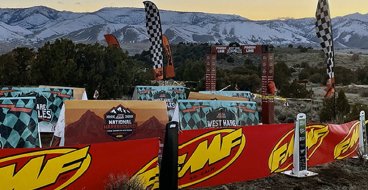
A banner is a horizontal surface that needs something to attach to — fencing, a barrier, a wall, a scaffold. It carries the most artwork of the three and it is what a spectator reads when they are already standing still.
A pole flag is vertical, portable and needs no structure. It marks a position — a team pit, a sponsor stand, a gate — and it reads from further away than a banner because it moves.
A sun blade is a feather flag on a tall pole. It exists for one reason: height. When a banner would be hidden behind vehicles, tents or people, a sun blade is still visible over the top of all of it.
If you only take one thing from this page: banners are for detail, flags are for position, sun blades are for being seen from the car park.
Banners: the surface that carries the most artwork
A banner is the only one of the three with enough continuous surface for a sponsor row, a class list, a schedule, or a full event identity with several logos in it. That is what it is for. It is also the cheapest way to cover a large area of fencing, which is why start straights and podium backdrops are almost always banners.
The constraint is that a banner needs a host structure. It has to be tied, clipped or framed onto something, and whatever it is tied to determines the aspect ratio. Fencing sets the height for you; a scaffold or truss lets you go wider. Measure the actual run before deciding the size, because a banner ordered to a round number and then fitted to a fence that is not that number ends up either sagging or folded over at one end.
Wind is the other consideration. A solid banner on a long run acts like a sail, which is what wind slits are for — and why a banner in an exposed venue should be specified differently from one going on an indoor wall.
See printed event banners for sizes, finishing and hardware options.
Flags: vertical, portable, and read from a distance
A pole flag does the job a banner cannot: it stands on its own. No fence, no wall, no fixing points. That makes it the right answer wherever the branding has to move — a team that changes pit position between rounds, a vendor who packs down each night, a sponsor presence that travels with a series.
Movement is also why a flag reads from further away than its surface area suggests. A static banner at the same distance is a rectangle; a flag in wind catches the eye first. That is worth knowing when the job is "make sure people find us" rather than "explain what we do".
The trade-off is artwork. A flag is narrow and it moves, so anything with small type or a lot of detail is wasted on it. One mark, one name, high contrast. Save the sponsor row for a banner.
The standard item is the 3′ × 5′ pole flag; the wider flag range covers other sizes, materials and hardware.
Sunblades: height where a banner cannot go
A sun blade — the tall, curved feather flag — solves a problem the other two cannot touch. At any busy venue, everything at head height is hidden behind vehicles, canopies and people by mid-morning. A sun blade puts your mark above all of it.
That is why they cluster at entrances, registration, vendor rows and pit lanes: the places where somebody is actively looking for you and cannot see over the crowd. A banner at the same spot is invisible from thirty metres in a full paddock.
They need a base, and the base is not an accessory — it is what determines whether the flag is still standing at the end of the day. Ground spike into grass or dirt, weighted base on tarmac. Getting that wrong is the single most common reason a sun blade spends the afternoon lying down.
The standard item is the 16′ feather sun blade with hardware; the sun blade range covers shorter sizes and the base options.
Choosing per location, not per product
The mistake is deciding "we are a flags event" and ordering twelve of them. Real venues need different things in different places, and it is easier to work location by location.
- Entrance or car park. Sun blades. The job is being seen from a distance by someone who does not yet know where to go.
- Registration or sign-in. A sun blade to find it, a banner to explain it. This is the one place both earn their keep.
- Start straight and fencing. Banners. There is structure to attach to and an audience standing still.
- Pits and team spaces. Pole flags. They move when the team moves.
- Vendor row. Sun blades, because every stand looks the same at eye level.
- Podium and photo area. A banner, sized to the shot rather than to the space. This is the image that ends up on social media.
Working through the venue in the order a visitor walks it is the fastest way to build the list — that is exactly what the race weekend signage checklist does.
What we need from you, and what changes the cost
All three are printed from the same artwork, so supplying it once covers the set. A vector logo is always better than a raster one — it scales to a sixteen-foot flag without softening, which a file pulled from a website will not. The artwork preparation guide covers the formats in detail, and it applies to signage exactly as it does to awards.
What moves the price is size, quantity, and whether the piece is single or double sided. What does not move it is having several different designs in one order — the setup is per artwork, so a banner, two flags and a sun blade all carrying the same event identity is cheaper than it sounds.
The one thing worth ordering alongside the awards rather than separately: if the same logo is going on the trophies and the signage, doing both on one job means the artwork is approved once and matches everywhere. Sponsors notice when it does not.
Frequently Asked Questions
What is the difference between a flag and a sun blade?
A pole flag is a rectangular flag on a standard pole, usually 3′ × 5′, and it marks a position at roughly head height and above. A sun blade is a tall curved feather flag, typically 16′, and it exists to be visible over vehicles, tents and crowds. Choose the flag to mark a spot, the sun blade to be found from a distance.
Do banners come with a way to hang them?
Hardware and finishing options are specified with the banner, because how it is fixed depends entirely on what it is fixed to. Tell us whether it is going on fencing, a wall, a frame or a truss and we will specify the finishing to match.
Will a banner survive being outdoors all season?
Outdoor-rated material is the default for event signage, but the biggest factor in how long it lasts is wind exposure rather than sun or rain. A long banner on an open fence line should be specified with wind slits; the same banner on a sheltered wall does not need them.
Can I get the same artwork on the awards and the signage?
Yes, and it is the reason to order them together. The artwork is set up once and applied across both, so the trophies, the banners and the flags carry the same marks in the same colours. Ordering them separately is how the two end up not quite matching.
What size flag or banner should I order?
For banners, measure the run you are fixing it to before choosing a size — the structure sets the proportions. For flags and sun blades the standard sizes cover almost every use, and the decision is usually how many positions you need to mark rather than how big each one is.
Is there a minimum order on event items?
No. A single banner for a podium backdrop is a normal order, and so is a full set of signage for a season of rounds.
Need the signage as well as the awards?
Send us the venue layout and your artwork and we will work out what goes where, then proof the whole set together.
See all event items


